Dark Web vs Deep Web: Key Differences
Dark web vs deep web: understand what separates them. The deep web holds your email and banking data. The dark web requires Tor and carries serious risks.
 Michael Gargiulo
Bottom Line: The deep web stores everyday private data like email and banking accounts. It makes up 90–95% of the internet. The dark web is a tiny, intentionally concealed slice requiring Tor to access, with significantly higher risks including scams, malware, and potential legal exposure.
The deep web and dark web are not the same thing. Most people confuse them, but the differences affect your security. This guide compares both side by side, explains the real risks, and shows you how to stay safe on every layer of the internet.
Dark Web vs. Deep Web: 5 Key Differences at a Glance
Many people mix up these two terms. The table below breaks down every major distinction in plain language.
| Feature | Deep Web | Dark Web |
|---|---|---|
| Share of the internet | ~90–95% of all online content | Less than 0.01% of the deep web |
| Access method | Standard browser (Chrome, Firefox) with login credentials | Tor browser or similar anonymizing software required |
| Common content | Email inboxes, bank portals, medical records, corporate intranets | Anonymous marketplaces, encrypted forums, whistleblower drop sites |
| Indexed by search engines | No | No |
| Encryption level | Varies by site (HTTPS, portal-level auth) | High — multi-layer onion routing by default |
| Legal status | Fully legal to access and use | Legal to access; much hosted content violates laws |
| Risk level | Low when you use strong passwords and updated software | High — scams, malware, law enforcement monitoring |
| Legitimate uses | Everyday private data storage and transactions | Secure channels for journalists, activists, privacy seekers |
1. Access Method Separates the Two Layers
You reach the deep web every time you log into your email or check a bank balance. Any standard browser works. The dark web requires the Tor browser, which routes traffic through at least three encrypted relays before reaching a .onion site. Without Tor, dark web addresses simply do not resolve.
2. Size and Scope Are Vastly Different
The deep web accounts for roughly 90–95% of the entire internet. Corporate intranets, academic databases, health records, and subscription services all live here. The dark web occupies a fraction of a percent of that space. Researchers at Recorded Future estimated only about 55,000 .onion domains exist at any given time, and most are inactive.
3. Legal Exposure Varies Dramatically
Accessing your email on the deep web carries zero legal risk. The dark web is different. While opening the Tor browser itself is legal in most countries, many dark web sites host illegal goods. Stumbling onto illicit content can trigger law enforcement scrutiny. The FBI’s 2023 Internet Crime Report documented over $12.5 billion in losses linked to cybercrime, with dark web marketplaces playing a significant role.
4. Anonymity Levels Differ by Design
Deep web sites authenticate users with standard logins. Your IP address is visible to the service provider. The dark web uses onion routing to obscure both visitor and host identities. Each relay in the Tor network strips one layer of encryption, so no single node sees the full path. This layered anonymity attracts both privacy advocates and criminals.
5. Risk Exposure Is Not Even Close
Deep web risks boil down to weak passwords and unpatched software. A 2024 Verizon Data Breach Investigations Report found that 81% of breaches involve stolen or weak credentials. Dark web risks are far more severe: malware-laced downloads, phishing traps, exit scams, and surveillance. A single wrong click on a dark web marketplace can install a remote-access trojan on your machine.
Knowing these five differences helps you make smarter decisions about your online safety. The deep web is routine. The dark web demands extreme caution.
What Is the Deep Web?
The deep web consists of all internet content that search engines like Google cannot index. This includes your emails, bank account portals, and subscription services.
Examples:
→ Private corporate intranets where employees share confidential documents → Academic databases holding research papers and journals → Personal portals such as online banking or email accounts
Key Point: The deep web makes up about 90–95% of the internet’s content. It is where most everyday private data lives.
What Is the Dark Web?
The dark web is a small, intentionally hidden portion of the deep web. You cannot access it with a regular browser. You need a specialized tool like the Tor browser.
Examples:
→ Anonymous marketplaces where buyers and sellers conceal their identities → Forums used by cybercriminals to coordinate illegal activities → Secure channels where activists and whistleblowers communicate anonymously
Key Point: The dark web is infamous for illegal activity, but it also serves people who need extra privacy. Journalists in authoritarian regimes and whistleblowers rely on it for protection.
Risks of Accessing the Deep Web and Dark Web
Both layers carry risks, but the severity differs by orders of magnitude. Understanding these risks is the first step toward protecting yourself.
Deep Web Risks Stay Manageable
→ Data Breaches from Weak Credentials: The deep web stores sensitive information like banking details and medical records. Weak or reused passwords put that data at risk. Use a password manager to generate unique credentials for every account.
→ Unpatched Software Opens Doors: Many deep web services use login portals that depend on up-to-date software. Outdated browsers or plugins give attackers a foothold.
→ Hidden Malicious Content: Poorly secured deep web sites may inadvertently host malicious content that infects your device. Keep antivirus software active at all times.
Dark Web Risks Are Severe
→ Scams and Fraud: Fraudulent schemes dominate the dark web. Fake marketplaces collect cryptocurrency payments and disappear. In 2023, exit scams on dark web markets cost users an estimated $100 million.
→ Malware and Cyber Attacks: Many dark web sites distribute trojans, keyloggers, and ransomware. One wrong click can hand full control of your device to an attacker.
→ Accidental Exposure to Illegal Content: Without careful navigation, you might land on pages hosting illegal material. This alone can create legal problems depending on your jurisdiction.
→ Law Enforcement Monitoring: Agencies like the FBI, Europol, and Interpol actively monitor dark web marketplaces. Your IP address or browsing patterns could draw attention even if you are not engaged in illegal activity.
The deep web is safe when you follow basic security habits. The dark web demands specialized tools, extreme caution, and a clear understanding of the legal landscape.
Case Study: The Silk Road Takedown
In 2011, a marketplace called Silk Road launched on the dark web. It operated through Tor and accepted only Bitcoin payments. By the time the FBI shut it down in October 2013, Silk Road had processed roughly $1.2 billion in transactions.
The site’s founder, Ross Ulbricht (known online as “Dread Pirate Roberts”), was arrested after investigators traced a series of operational mistakes. A leaked email address, a forum post under his real name, and server misconfigurations gave agents the trail they needed.
The FBI seized 144,000 Bitcoins from Ulbricht’s accounts. At current prices, that haul would exceed $9 billion.
The Silk Road case proved three things. First, onion routing does not protect against human error. Second, cryptocurrency transactions leave traceable patterns when users slip up. Third, international law enforcement cooperation can penetrate even the most hidden corners of the internet.
Emerging Trends Shaping the Hidden Internet
The hidden internet evolves constantly. These four trends matter most right now.
AI-Powered Dark Web Monitoring
Security teams now use artificial intelligence to scan dark web forums and marketplaces in real time. These tools flag stolen credentials, leaked databases, and new malware strains within minutes of their appearance. Companies like Recorded Future and Flashpoint process millions of dark web data points daily, correlating findings with broader threat intelligence feeds.
Law Enforcement Crackdowns Accelerate
International police forces have shut down multiple major dark web markets in recent years. Operation SpecTor in 2023 resulted in 288 arrests across nine countries and seized $53.4 million in cash and cryptocurrency. These coordinated raids show that dark web anonymity has clear limits.
Scams Grow More Sophisticated
The “Kill List” scam claimed to offer hitman services. Investigators confirmed no actual violence occurred. The site existed purely to collect Bitcoin from frightened victims. AI-generated phishing pages now mimic legitimate dark web marketplaces with alarming accuracy, making scam detection harder than ever.
Cryptocurrency Forensics Improve
Blockchain analysis firms like Chainalysis trace dark web transactions with increasing precision. In 2023, Chainalysis helped law enforcement recover over $2 billion in illicit cryptocurrency. Privacy coins like Monero add complexity, but forensic techniques continue to close the gap.
The financial stakes are staggering. Cybercrime inflicts an estimated $10.5 trillion in global damage annually. That figure rivals the GDP of several major nations combined.
Why Should You Care?
Understanding these distinctions affects everyone who uses the internet. Here is why it matters for three specific groups.
Cybersecurity Professionals Build Better Defenses
Knowing how the deep web and dark web operate helps security teams build stronger threat detection systems. Dark web monitoring can reveal stolen employee credentials before attackers use them. Early-warning intelligence from hidden forums gives defenders a head start.
Individual Users Protect Their Privacy
You do not need to be a security expert to benefit from this knowledge. Recognizing that your email inbox sits on the deep web reinforces why strong passwords matter. Understanding the dark web’s risks helps you avoid phishing traps and social engineering attacks that originate there.
Society Benefits from Informed Policy
When lawmakers understand these distinctions, they craft better regulations. International cooperation against cybercrime depends on accurate terminology. Conflating “deep web” with “dark web” leads to misguided policies that harm legitimate privacy tools.
How to Safely Navigate These Hidden Layers
Staying safe requires different strategies for each layer. A VPN is your baseline defense on both.
Best Practices for the Deep Web
→ Use Strong, Unique Passwords: A password manager generates and stores credentials so you never reuse them across accounts.
→ Connect Through a VPN: A VPN encrypts your traffic between your device and the VPN server, blocking ISPs and network snoops from seeing what you access. Providers like NordVPN, ExpressVPN, and CyberGhost offer strong encryption and no-log policies.
→ Keep Software Updated: Patch your browser, operating system, and plugins as soon as updates release. Unpatched vulnerabilities account for a significant share of breaches.
Important: Cybercrime inflicts an estimated $10.5 trillion in global damage annually. Even casual dark web browsing carries real risk. A single wrong click can expose your device to malware or place you under law enforcement scrutiny. If you access it at all, use the official Tor browser combined with a VPN, and never enter personal information.
Best Practices for the Dark Web
→ Download Tor from Its Official Source: Always get the Tor browser directly from torproject.org. Fake versions bundled with malware circulate on download sites.
→ Layer a VPN Under Tor: Connecting to a VPN before opening Tor hides your Tor usage from your ISP. This “VPN over Tor” setup adds a critical privacy layer.
→ Never Share Personal Information: Do not use real names, email addresses, or payment methods tied to your identity on any dark web site.
→ Treat Every Link as Suspicious: The dark web is saturated with phishing traps and malware-laced pages. Verify .onion addresses through trusted directories before clicking.
Recommended Tools and Resources
→ Safe Search Engines: Ahmia indexes .onion sites and filters out many fraudulent clones. It is one of the few search engines that operate on the clear web while indexing dark web content.
→ Dark Web Monitoring Services: Tools like Have I Been Pwned and commercial monitoring platforms alert you if your credentials appear in dark web data dumps.
→ VPN Deals: Securing your connection is step one. For discounted rates on NordVPN, ExpressVPN, and CyberGhost, visit www.vpn.com/ for current offers.
Key Point: Whether you use the deep web for everyday tasks or explore the dark web for research, a trusted VPN combined with strong security habits is your best defense.
Final Verdict
The deep web is the vast hidden layer of the internet that stores your emails, bank records, and medical data. It makes up 90–95% of all online content and is safe when you use strong credentials and updated software.
The dark web occupies a tiny fraction of that space. It requires the Tor browser, uses layered encryption, and carries serious risks including malware, scams, and law enforcement monitoring. It also serves legitimate purposes for whistleblowers, journalists, and privacy advocates.
Knowing the difference protects you. Use strong passwords for deep web accounts. Combine a VPN with the Tor browser if you ever access the dark web. Keep all software patched. Monitor your credentials through breach notification services.
Your security starts with understanding which layer of the internet you are on and acting accordingly.
Resources for this page
Charts and reference images from our testing, free to view and share.
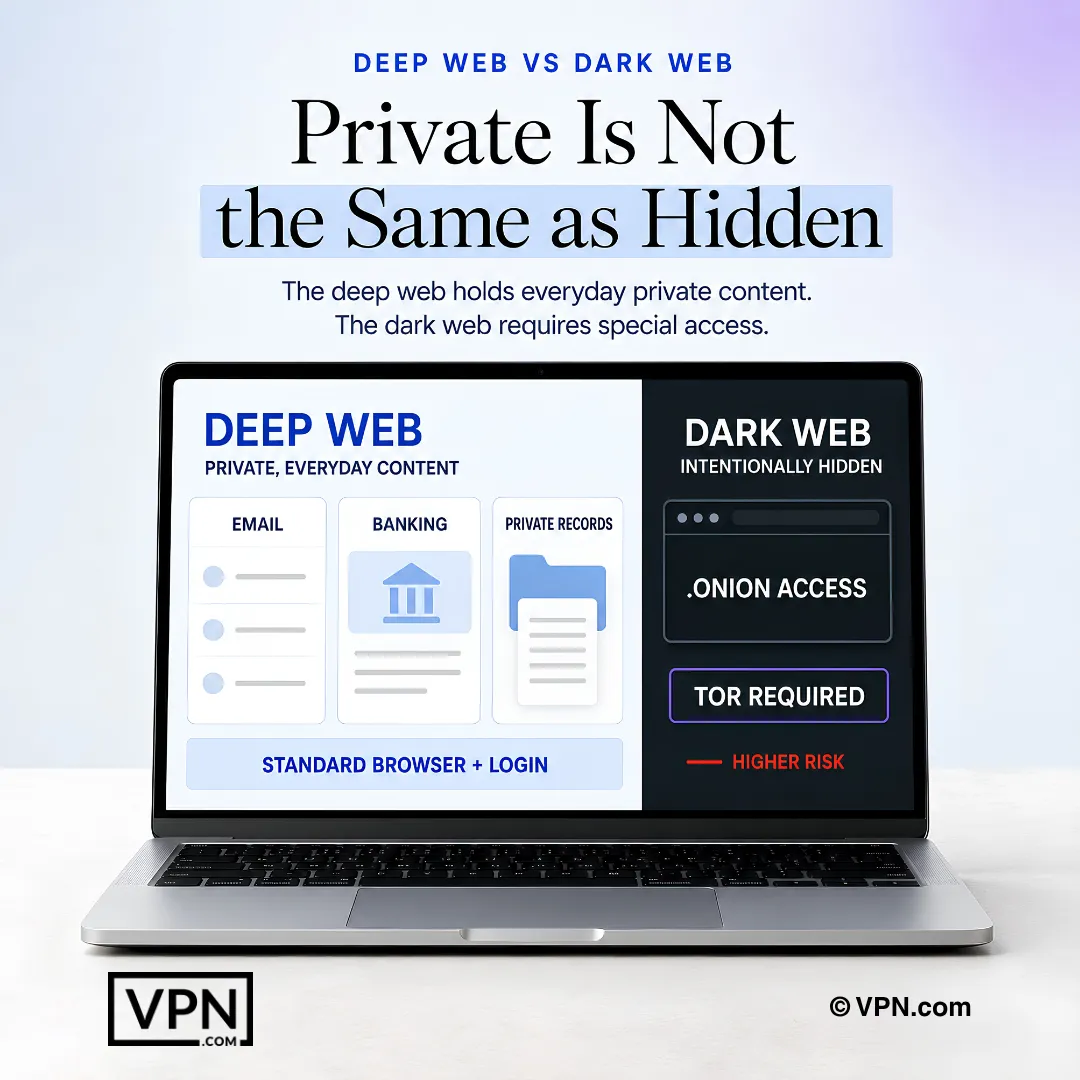
The deep web contains ordinary private content, while the dark web requires specialized access and carries greater risk.
Frequently Asked Questions
What’s the fundamental difference between the deep web and the dark web?
The deep web is any content search engines can’t index, like email inboxes and bank portals, making up roughly 90-95% of the internet. The dark web is a deliberately hidden subset of that space, reachable only through Tor, accounting for less than 0.01% of the deep web itself. The deep web is fully legal to use; the dark web hosts much illegal content alongside legitimate uses.
How do you actually access the deep web versus the dark web?
You reach the deep web with a standard browser like Chrome or Firefox plus login credentials, no special software required. The dark web requires the Tor browser, which routes traffic through at least three encrypted relays before reaching a .onion address. Without Tor, those addresses simply won’t resolve, and neither layer shows up in Google search results.
Why does the dark web carry so much more risk than the deep web?
The gap between the two is orders of magnitude wide. Deep web risks stem mainly from weak passwords and unpatched software, and a 2024 Verizon Data Breach Investigations Report found 81% of breaches involve stolen or weak credentials. Dark web risks include malware-laced downloads, phishing traps, exit scams, and active monitoring by agencies like the FBI, Europol, and Interpol.
Is it illegal to access the dark web?
Opening the Tor browser and browsing the dark web is legal in most countries, but much of what’s hosted there, including marketplaces selling illegal goods, violates the law. Stumbling onto illicit content can trigger law enforcement scrutiny even without intent to break any rules. The FBI’s 2023 Internet Crime Report tied dark web marketplaces to a significant share of documented cybercrime losses.
How big is the dark web compared to the rest of the internet?
It’s tiny by comparison. The deep web makes up roughly 90-95% of all online content, while the dark web occupies less than 0.01% of that space. Researchers at Recorded Future estimate only about 55,000 .onion domains exist at any given time, and most of those sit inactive rather than actively serving content to visitors.
What actually happened in the Silk Road takedown, and what does it teach about dark web anonymity?
Silk Road launched on the dark web in 2011 and operated exclusively through Tor with Bitcoin payments until the FBI shut it down in October 2013. Founder Ross Ulbricht was traced through a leaked email address, a forum post under his real name, and server misconfigurations, human errors rather than a flaw in Tor itself. The FBI seized 144,000 Bitcoins from his accounts.
Do I need a VPN just to check my email or bank account on the deep web?
It isn’t strictly required, but it adds real protection by encrypting traffic between your device and the VPN server so ISPs and network snoops can’t see what you’re accessing. Providers like NordVPN, ExpressVPN, and CyberGhost pair strong encryption with no-log policies, and pairing that with a password manager and updated software covers most deep web risk.
Should I use a VPN together with Tor before browsing the dark web?
Yes, connecting to a VPN before opening Tor, known as VPN over Tor, hides the fact that you’re using Tor at all from your ISP. This adds a privacy layer on top of Tor’s own onion routing, which strips one layer of encryption at each of at least three relays. Only pair it with the official Tor browser downloaded from torproject.org.
What tools can tell me if my credentials ended up on the dark web?
Have I Been Pwned checks whether your email or passwords have surfaced in known dark web data dumps, and commercial dark web monitoring platforms offer similar alerts for organizations. Ahmia is a clear-web search engine that indexes .onion sites while filtering out many fraudulent clones, useful for checking exposure without installing Tor yourself.
What’s the safest way to set up Tor if I need to access the dark web for research?
Download Tor only from its official source at torproject.org, since fake bundled versions carrying malware circulate elsewhere. Connect through a VPN first so your ISP can’t see you’re using Tor, then verify any .onion address through a trusted directory like Ahmia before clicking. Never enter real names, emails, or payment details tied to your identity.
What happens if I accidentally land on illegal content while on the dark web?
This can create legal exposure depending on your jurisdiction, even without any intent to break the law. Close the page immediately and avoid downloading or interacting with anything on it. Casual dark web browsing carries this exact risk, since agencies like the FBI, Europol, and Interpol actively monitor marketplaces regardless of individual intent.
How do I avoid scams on dark web marketplaces?
Treat every link as suspicious by default, since the space is saturated with phishing traps and malware-laced pages. Verify .onion addresses through a trusted directory like Ahmia before visiting, and never send cryptocurrency to a marketplace you can’t independently confirm. Exit scams, where a fake marketplace collects payment and simply disappears, are a documented and common pattern there.
Are law enforcement agencies actually watching dark web marketplaces?
Yes. Agencies including the FBI, Europol, and Interpol actively monitor dark web marketplaces, and coordinated operations have real reach: Operation SpecTor in 2023 resulted in 288 arrests across nine countries. Your IP address or browsing patterns can draw attention even if you’re not personally engaged in illegal activity, since surveillance targets the marketplace itself, not just individual buyers.