The Top Online Scams: You Can’t Afford to Ignore
Think you’re safe? Online scams are getting sneakier by the day. Don’t be their next victim! Learn the latest scam tactics & how to fight back. Click to Read!
 Michael Gargiulo
Bottom Line: Global losses from online scams reached $1.03 trillion, with AI making fraudulent messages and deepfakes increasingly convincing. Staying safe requires skepticism toward unsolicited communications, verification before acting, and security tools including antivirus and VPN.
The internet has made life easier. It has also opened the door to online scams. These fraudulent schemes steal your money, personal information, or both by exploiting trust, fear, or greed.
Online scams have grown more sophisticated than ever. Artificial intelligence now creates realistic deepfake videos and voice clones. Last year alone, global losses from online scams reached $1.03 trillion. In the U.S., losses hit $12.5 billion, according to the Federal Trade Commission (FTC)and Experian.
This guide explains what online scams are, lists the most common types, and shares practical tips to protect yourself. Whether it’s romance scams, lottery fraud, or banking theft, staying informed is your best defense.
What Is an Online Scam?
An online scam is a deceptive tactic internet scammers use to trick people into giving away money or personal details. These schemes operate through email, text messages, social media, or fake websites.
The definition covers any scheme designed to exploit victims. Scammers often use psychological tactics like urgency or manufactured trust. For example, they may pose as your bank or pretend to be a romantic partner.
The U.S. saw 2.6 million fraud reports in the most recent reporting year. Imposter scams alone cost victims $2.7 billion. These scams keep growing because AI makes fakes harder to spot.
Why Digital Fraud Keeps Growing
Scams thrive for several clear reasons:
- AI lowers the barrier. Scammers generate realistic deepfake videos, voice clones, and tailored phishing emails that look legitimate.
- The internet provides global reach. Criminals target people worldwide while staying anonymous.
- Emotions drive decisions. Scammers exploit fear (fake IRS calls) and greed (crypto schemes).
- Economic uncertainty creates vulnerability. People fall for investment scams promising quick returns during financial stress.
- Regulation gaps persist. Platforms like cryptocurrency exchanges lack oversight, allowing fraud to flourish.
42% of UK adults were targeted by scams, with one in three losing money, according to NatWest Group.
Types of Online Scams and How They Work
The most common scam types are diverse and sophisticated. Below are detailed examples with red flags and prevention tips.
| Scam Type | How It Works | Reported Loss (US) | Key Red Flag |
|---|---|---|---|
| Imposter Scams | Pretend to be government, bank, or family | $2.7 billion | Urgent demand; gift card payment |
| Romance Scams | Fake profiles build trust then request money | $1.3 billion | Refuses video calls; fast emotional bond |
| Investment / Crypto Scams | Promise high returns on fake platforms | 80% victim loss rate | Guaranteed returns; pressure to act fast |
| Phishing | Fake emails/sites steal credentials | 40% of BBB reports | Generic greeting; suspicious link |
| Online Shopping Scams | Fake listings take payment, no delivery | 40% of BBB reports | No HTTPS; price too good to be true |
| Job Scams | Fake work offers require upfront payment | 1,500+ cases (Singapore) | Vague details; fee to start working |
| Tech Support Scams | Fake pop-ups or calls claim PC issues | Unreported | Unsolicited contact; remote access request |
| AI-Powered Scams | Deepfake video/voice to impersonate others | Rising fast | Verify via trusted callback |
Imposter Scams
Imposter scams involve criminals pretending to be someone trustworthy. They pose as government officials, bank representatives, or family members to steal money or data.
In a typical banking imposter scam, a caller claims your account is compromised and demands your login credentials. These scams cost Americans $2.7 billion. Red flags include urgent demands and requests for gift card payments. Always verify identities through official channels. Never share personal info with unsolicited callers.
Phishing Attacks That Steal Your Credentials
Phishing scamsuse fake emails, texts, or websites to trick you into sharing passwords or credit card numbers. A common example involves a fake bank login page that captures your real credentials.
40% of scams reported to the Better Business Bureau (BBB) were phishing. Look for spelling errors, generic greetings, and mismatched URLs. For prevention, avoid clicking suspicious links and enable two-factor authentication (2FA) on every account.
Romance Scams on Dating Sites
Online dating scams involve fake profiles on dating sites that build emotional trust before requesting money. Scammers claim emergencies like medical bills or travel costs.
Romance scams cost Americans $1.3 billion, according to the FTC. Red flags include fast-moving relationships and refusal to meet in person. Use reverse image searches and insist on video calls early in any online relationship.
Investment and Crypto Fraud
Investment scams promise high returns in cryptocurrency or stocks but deliver nothing. Fake crypto platforms had an 80% victim loss rate, per Experian. Watch for guaranteed returns and high-pressure tactics. Research investments thoroughly through SEC.gov and avoid unsolicited offers.
SMS Scams (Smishing)
Smishing involves fake texts from sources like delivery services. They ask for personal info or payment through malicious links. A common variant claims a package delivery issue and includes a link to a fake tracking page. Smishing was the fastest-growing scam type in the UK. Never respond to unknown texts. Verify claims through official carrier or retailer websites.
Job Scams
Job scams offer fake work-from-home positions that require upfront payments or personal information. In Singapore, over 1,500 cases were reported in a single year. Red flags include vague job details and payment demands before starting. Research companies on LinkedIn and Glassdoor. Never pay for a job opportunity.
Lottery and Advance Fee Scams
Lottery scams send fake winning notifications and demand fees to claim prizes. Advance fee scams follow the same pattern with loans, inheritances, or other promised rewards. The classic Nigerian prince scam is one example. Legitimate lotteries never require upfront fees. Ignore all unsolicited prize claims.
Charity Scams
Fake charities solicit donations, especially after natural disasters or crises. They use high-pressure tactics and unverified payment links. Verify any charity through CharityNavigator.org before donating. Look for the organization’s EIN number and financial disclosures.
Online Shopping Scams
Shopping scams involve fake websites or marketplace listings that accept payment without delivering products. 40% of BBB-reported scams were shopping-related. Look for missing “https,” unrealistic prices, and no return policy. Shop only on established retailers or verified marketplace sellers.
Tech Support Scams
Tech support scams use fake calls or browser pop-ups claiming your computer has critical issues. Scammers pose as Microsoft or Apple support and charge fees for unnecessary “fixes.” Never give remote access to unsolicited callers. Contact tech companies directly through their official websites.
AI-Powered Scams Using Deepfakes
AI-powered scams use realistic deepfake videos or voice clones to impersonate trusted people. A scammer might mimic a family member’s voice to create urgency. Verify all urgent financial requests through a separate, trusted communication channel. Tools like Deepware Scanner can help detect manipulated media.
Identity Theft Through Digital Channels
Identity theft scamstarget personal information to open accounts or commit fraud in your name. Watch for unexplained account activity or credit inquiries you didn’t initiate. Monitor credit reports weekly and consider identity protection services like LifeLock.
Social Media and Dating App Scams
Social media scams use fake profiles, cloned accounts, or fraudulent giveaway posts to steal info or money.Dating app scams follow similar patterns, with fake profiles extracting money through fabricated emergencies. Verify profiles independently. Report suspicious accounts to the platform immediately.
Pyramid Schemes and Fake Check Scams
Pyramid schemes promise earnings for recruiting others rather than selling real products. They collapse when recruitment slows. Fake check scams involve depositing a fraudulent check and returning “overpayment” before the check bounces. Avoid depositing checks from unknown sources. Wait for full bank clearance before spending any deposited funds.
How to Spot a Scammer Before It’s Too Late
Recognizing a scam early can save you money and personal data. Watch for these warning signs:
- Urgency and panic. Scammers create pressure to rush decisions. They claim your bank account is at risk or a deal expires in minutes. Take time to verify before acting.
- Unusual payment requests. Demands for gift cards, cryptocurrency, or wire transfers are major red flags. Legitimate businesses rarely use these methods.
- Poor grammar and sloppy design. Phishing emails and fake websites often contain spelling mistakes, broken layouts, or mismatched logos.
- Offers that sound too good. Promises of huge lottery winnings, guaranteed investment returns, or free products signal fraud.
- Unsolicited contact. Unexpected calls, texts, or emails asking for money or personal details are scam indicators. Verify the source through official channels before responding.
How to Protect Yourself from Digital Fraud
Avoiding scams requires consistent habits. Here are the most effective protections:
- Question unsolicited communications. Don’t trust unexpected emails, texts, or calls asking for money or info. Verify through official websites like IRS.gov or your bank’s published phone number.
- Verify before acting. Check website legitimacy by confirming “https” and reading reviews. Verify charities through CharityNavigator.org before donating.
- Protect personal information. Use strong, unique passwords for every account. Enable 2FA everywhere. Tools like Google Password Manager flag compromised credentials.
- Choose safe payment methods. Avoid untraceable payments like gift cards or crypto. Use credit cards or PayPal for built-in fraud protection, especially for online purchases.
- Install security software. Antivirus tools like Norton or Malwarebytes block malicious links. Use a VPN like NordVPNon public Wi-Fi to encrypt traffic and reduce phishing risks.
- Stay informed. Follow updates from the FTC, FBI, or cybersecurity publications. AI voice scams targeting seniors are rising fast. Subscribe to FTC alerts for timely warnings.
- Educate vulnerable groups. Seniors are prime targets for romance scams and tech support fraud. Teach them to verify calls and never share personal information with strangers.
What to Do If You Get Scammed
If you fall for a scam, act immediately to limit damage:
- Stop all contact. Block the scammer’s number, email, or profile. Do not engage further.
- Report the scam. File reports with the FTC at ftc.gov[1], the FBI’s IC3 at ic3.gov[2], or Action Fraud in the UK at actionfraud.police.uk[3]. For platform-specific scams, contact the company directly.
- Notify your bank. If you shared financial details, alert your bank to freeze accounts or reverse transactions.
- Monitor your accounts. Check bank statements and credit reports for unauthorized activity. Catching fraud early limits losses.
- Change all passwords. Update credentials and enable 2FA on every affected account.
- Seek professional help. Use identity protection services like Experian’s IdentityWorks or consult local police for significant losses.
Important: If you’ve been scammed, report it immediately. In the US, file with the FTC at ftc.gov and the FBI’s IC3 at ic3.gov. In the UK, use Action Fraud at actionfraud.police.uk. Quick reporting can freeze fraudulent transactions and helps authorities track serial scammers.
Can You Recover Lost Money?
Recovering money from a scam is difficult but sometimes possible. Contact your bank immediately for banking fraud. Banks may reverse transactions if reported within 24-48 hours. Use credit card or PayPal fraud protection for shopping scams. File reports with the FTC or IC3, which may assist with recovery in significant cases. For large losses, consult a fraud recovery attorney. Act fast because delays reduce recovery chances significantly.
Final Verdict
Online scams pose a serious and growing threat as AI makes fraud harder to detect. From phishing to social media schemes, the most common scams exploit both trust and technology.
Stay skeptical of unsolicited communications. Verify before acting. Use security tools including antivirus and VPN. Report every scam attempt to help authorities track criminals.
The best defense combines awareness, verified tools, and fast action when something looks wrong. Protect yourself and share what you learn with others who may be vulnerable.
Disclaimer: Scam tactics evolve quickly. Verify the latest information with sources like the FTC or cybersecurity publications. Use protective tools and report scams responsibly, complying with local laws.
References
Resources for this page
Charts and reference images from our testing, free to view and share.
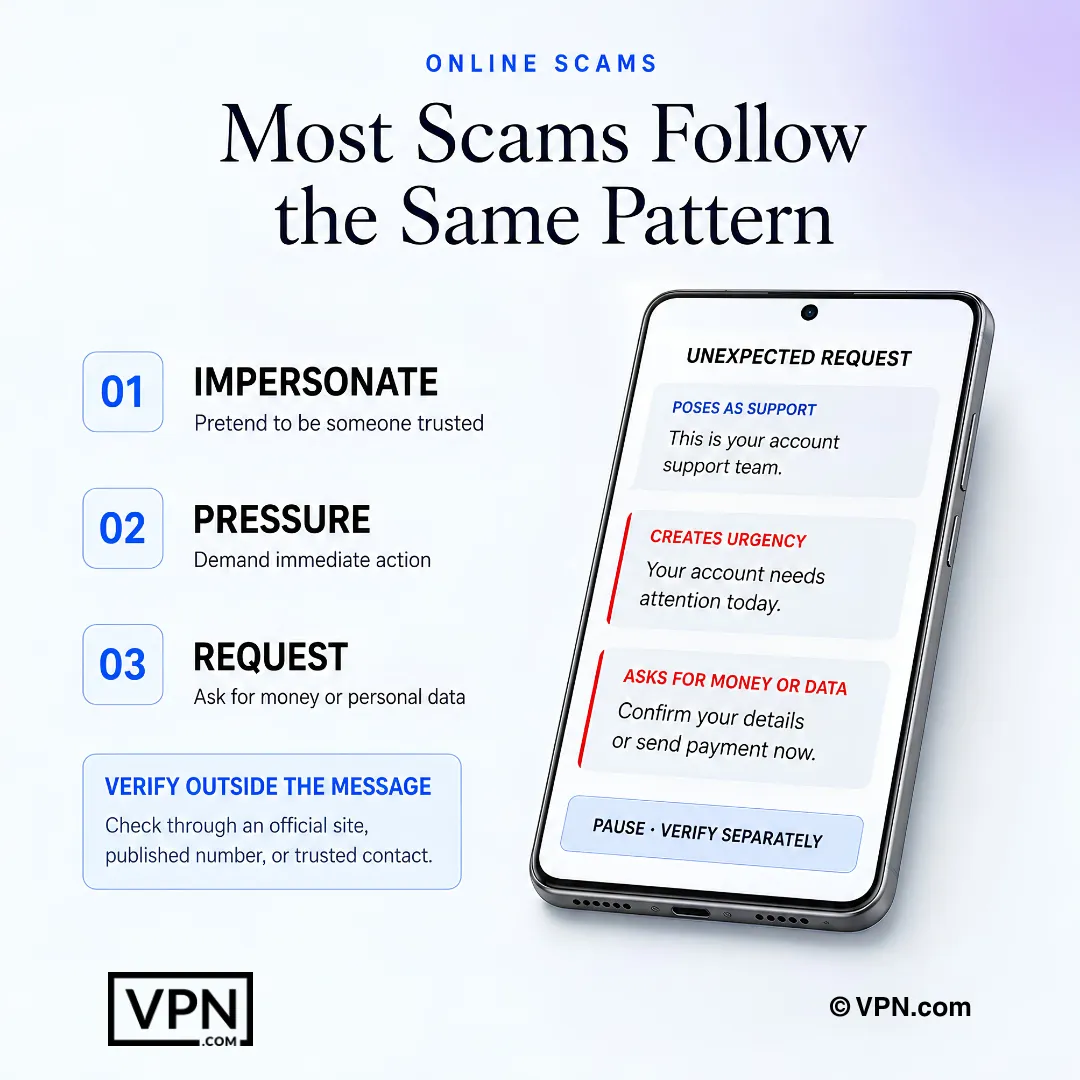
Most online scams impersonate someone trusted, create urgency, and then request money or sensitive information.
Frequently Asked Questions
What exactly counts as an online scam?
An online scam is any deceptive scheme run through email, text, social media, or fake websites designed to trick you into handing over money or personal details. Scammers exploit urgency, fear, or manufactured trust, posing as banks, government agencies, or romantic partners. Global losses reached $1.03 trillion last year, with U.S. losses hitting $12.5 billion and 2.6 million fraud reports filed.
What are the most common types of online scams right now?
Imposter scams top the list at $2.7 billion in U.S. losses, followed by romance scams at $1.3 billion. Phishing and online shopping scams each account for 40% of Better Business Bureau reports, while investment and crypto fraud carries an 80% victim loss rate. Job scams, smishing, tech support fraud, and AI-powered deepfake scams round out the fastest-growing categories.
How do imposter scams typically work?
A scammer poses as your bank, a government official, or a family member, often claiming your account is compromised to pressure you into sharing login credentials or making a payment. These scams cost Americans $2.7 billion. Red flags include urgent demands and requests for gift card payment. Always verify identity through official channels rather than a callback number the caller provides.
How do romance scams unfold on dating apps?
Scammers build fake profiles and emotional trust over weeks before inventing an emergency, like medical bills or travel costs, to request money. Romance scams cost Americans $1.3 billion, according to FTC data. Red flags include a fast-moving relationship and refusal to do video calls. Use reverse image searches on profile photos and insist on a video call early.
What makes AI-powered deepfake scams harder to catch than older scams?
AI now generates realistic deepfake videos and voice clones, letting scammers mimic a family member’s voice to create false urgency, something older text-based scams couldn’t do. This category is rising fast alongside AI-generated phishing emails. Verify any urgent financial request through a separate, trusted communication channel, and tools like Deepware Scanner can help flag manipulated media.
How risky are investment and crypto scams compared to other types?
Investment and crypto scams carry an 80% victim loss rate, per Experian, among the highest of any scam category, driven by promises of guaranteed returns on fake platforms. Watch for high-pressure tactics and unsolicited offers. Research any opportunity through SEC.gov first, since legitimate investments never guarantee returns or demand immediate action.
How can I spot a scam before it costs me money?
Watch for five consistent warning signs: manufactured urgency, unusual payment requests like gift cards or crypto, poor grammar or mismatched logos, offers that sound too good to be true, and unsolicited contact demanding money or personal details. NatWest Group found 42% of UK adults were targeted by scams, with one in three losing money, underscoring how common these red flags are.
What payment methods should I avoid to reduce scam risk?
Avoid gift cards, cryptocurrency, and wire transfers, all untraceable methods scammers favor since they can’t be reversed. Instead use credit cards or PayPal, which carry built-in fraud protection, especially for online purchases. Imposter scams specifically rely on gift card payment demands as a key red flag, so any request for one should end the conversation immediately.
What security tools actually help prevent online scams?
Antivirus software like Norton or Malwarebytes blocks malicious links before they load, while a VPN like NordVPN encrypts your traffic on public Wi-Fi to reduce phishing exposure. Google Password Manager flags compromised credentials, and Deepware Scanner helps detect manipulated deepfake media. For identity theft specifically, services like LifeLock or Experian’s IdentityWorks add ongoing credit monitoring.
How do I protect elderly family members from scams?
Seniors are prime targets for romance scams and tech support fraud specifically. Teach them to verify any caller through an official number they look up independently, never a number the caller provides, and to never share personal information with unsolicited contacts. AI voice scams cloning a family member’s voice are rising fast, so agree on a verification phrase in advance.
What should I do immediately if I realize I’ve been scammed?
Stop all contact with the scammer immediately by blocking their number, email, or profile. Notify your bank to freeze accounts or reverse transactions, then change passwords and enable 2FA on every affected account. Report the incident to the FTC at ftc.gov or the FBI’s IC3 at ic3.gov, since quick reporting can help freeze fraudulent transactions.
Can I actually get my money back after falling for a scam?
Sometimes, but speed matters. Banks may reverse transactions if you report banking fraud within 24 to 48 hours, and credit card or PayPal purchases carry built-in fraud protection for shopping scams. The FTC or IC3 may assist with recovery in significant cases, and a fraud recovery attorney is worth consulting for large losses. Delays sharply reduce your chances of recovery.
Who do I report an online scam to?
In the U.S., file with the FTC at ftc.gov or the FBI’s Internet Crime Complaint Center at ic3.gov. In the UK, report to Action Fraud at actionfraud.police.uk. For platform-specific scams like fake social media profiles or marketplace listings, also report directly to the company. Fast reporting helps authorities track serial scammers and can limit further victims.