Domain Valuation: How Much Is Your Domain Worth?
Get an accurate domain valuation from VPN.com. We assess comparable sales, traffic, brand potential, and market demand to price your domain correctly.
Premium Domain Broker
Pay less. Earn more. Stay anonymous.
Looking to buy or sell a domain? We can help.
What Determines How Much Your Domain Is Worth
Domain valuation combines comparable sales data, keyword demand, extension strength, and brandability into a defensible price range. Automated tools miss 60-70% of a domain’s true market value because they ignore negotiation context, buyer motivation, and timing. As your premium domain broker, VPN.com provides expert valuations backed by over $100M in portfolio and transactions, not algorithms, whether you plan to buy a premium domain or sell one.
Six Factors That Drive Domain Value
Every domain sits on a spectrum from worthless to seven figures. These six factors determine where yours lands.
Comparable Sales Set the Baseline
Recent sales of similar domains anchor any credible valuation. A 4-letter .com sold for $38,000 last quarter. That data point shapes pricing for every other 4-letter .com on the market. Without comps, you are guessing.
VPN.com tracks private sale data that never appears in public databases. This access changes valuations by 30-50% in many cases.
Length and Simplicity Multiply Price
Shorter domains command higher prices. One-word .coms routinely sell for $500K to $15M. Two-word .coms range from $5K to $2M depending on category. Every additional character reduces value by roughly 10-15%.
Hyphens, numbers, and unusual spellings cut value dramatically. “InsuranceQuotes.com” is worth exponentially more than “Insurance-Quotez.com.”
Extension Matters More Than Most Sellers Admit
The .com extension still commands a 3-10x premium over alternatives. A .io domain worth $20K might fetch $150K as a .com. Country-code extensions like .co.uk or .de hold value in their markets but trade at steep discounts globally.
New extensions like .ai have surged in specific verticals. Context matters. A broker who understands extension trends prevents you from overpaying or underselling.
Brand Potential Is the Hidden Multiplier
Domains that sound like companies attract premium buyers. “Relay.com” carries more brand weight than “FastRelayServices.com.” Buyers pay for the ability to build a brand without explaining their URL.
One-word dictionary domains hold the most brand potential. They work across languages, industries, and product lines. This versatility pushes prices into seven figures.
Organic Traffic Creates Immediate ROI
A domain receiving 5,000 monthly visitors has a quantifiable revenue stream. Type-in traffic, aged backlinks, and existing search rankings turn a domain from a brand asset into a revenue asset.
Domains with 500+ referring domains and established authority can justify $50K-$500K premiums based on SEO value alone. Buyers calculate the cost of building that traffic from scratch.
Market Timing Shifts Value by 20-40%
Domain prices follow industry cycles. Health-related domains spiked 35-50% during 2020. AI domains jumped 200-400% between 2022 and 2024. Selling into a hot market or buying before a trend peaks changes the math entirely.
A broker who tracks these cycles protects your position on either side of the table.
Free and Paid Valuation Tools Fall Short
Several tools offer instant domain appraisals. Here is an honest breakdown.
GoDaddy Appraisal uses an algorithm trained on GoDaddy’s own marketplace data. It skews toward retail pricing and ignores private sales. Accuracy range: within 50% of true market value on commodity domains. Far worse on premium names.
Estibot aggregates comparable sales and keyword data. It handles mid-range domains ($1K-$50K) reasonably well. It fails on premium and brandable domains where subjective value dominates.
Paid services from firms like Sedo or Afternic offer human-reviewed appraisals for $50-$100. These improve accuracy but still lack private sale data and buyer-side intelligence.
None of these tools account for who is buying, why they need the domain, or what leverage exists in the negotiation. Those factors often matter more than the domain itself.
Why Automated Appraisals Get Domain Values Wrong
Algorithms process inputs. They cannot process intent.
They Miss Private Sale Data
Public domain sales represent roughly 30-40% of total transaction volume. The rest happens through brokers, private negotiations, and corporate acquisitions that never hit a database. Automated tools only see the public slice.
VPN.com bought VPN.com for $976K and saved $798K through expert negotiation. No algorithm would have predicted that outcome. The savings came from understanding the seller’s position and timing.
They Cannot Measure Buyer Motivation
A healthcare company rebranding after a merger will pay 3-5x what a startup would for the same domain. Automated tools assign one value. Reality assigns different values to different buyers at different times.
They Ignore Negotiation Leverage
The listed price of a domain means almost nothing. Opening asks run 2-10x above closing prices in most private transactions. A tool that spits out “$250,000” does not tell you whether $85,000 or $400,000 is the real number.
How VPN.com Values Domains With Broker-Grade Precision
Our valuation process goes deeper than any tool or algorithm can reach.
Step 1: Comparable Sales Analysis Using Private Data
We access both public databases and private deal records from over $100M in portfolio and transactions. This dual dataset produces comps that automated tools simply cannot match. We filter by extension, length, vertical, and recency.
Step 2: Keyword and Revenue Modeling
We analyze search volume, CPC rates, and monetization potential for every keyword in the domain. A domain containing a $45 CPC keyword has quantifiable advertising value that factors into our assessment.
Step 3: Buyer Universe Mapping
We identify the likely buyer pool for any domain. More potential buyers means more competitive pressure and higher realized value. A domain with 3 potential buyers is worth less than one with 30.
Step 4: Negotiation Intelligence
For buy-side clients, we assess seller motivation, holding costs, and historical pricing behavior. For sell-side clients, we identify which buyers have the budget and urgency to close at premium prices. This intelligence shapes the valuation range.
Every valuation we deliver includes a realistic range, not a single number. Markets move. Buyers vary. Ranges reflect reality.
Real Transactions Show How Valuation Works in Practice
We cannot name clients. We can share patterns from over $100M in portfolio and transactions.
Case 1: One-Word .Com Acquisition
A financial services firm targeted a one-word .com domain. Automated tools valued it at $1.2M. Our analysis of private comps, buyer competition, and seller history produced a range of $600K-$900K. We closed the deal at $715K. The client saved roughly $485K against the seller’s opening ask.
Case 2: Industry-Specific Domain for Market Entry
A SaaS company entering the cybersecurity vertical needed a category-defining domain. Public appraisals ranged from $80K to $200K. We identified the seller’s motivation to liquidate a portfolio and negotiated a $62K purchase. Timeline: 37 days from first contact to transfer.
Case 3: Sell-Side Premium Through Buyer Competition
A domain investor held a 2-word .com in the insurance vertical. They received a $150K offer and considered accepting. Our sell-side team identified 4 additional qualified buyers and created competitive tension. Final sale price: $340K. The commission paid for itself 6x over.
These outcomes require human intelligence. No tool replicates them.
Start With a Free Expert Valuation
Whether you are buying or selling, an accurate valuation is the foundation of every smart domain transaction. VPN.com provides complimentary broker-grade valuations with no obligation and no fee until a deal closes.
Our process is anonymous from the first call. Sellers never know who is buying. Buyers never tip their hand. Typical transactions close in 30–90 days.
Get Your Free Domain Valuation Now →
Resources for this page
Charts and reference images from our testing, free to view and share.
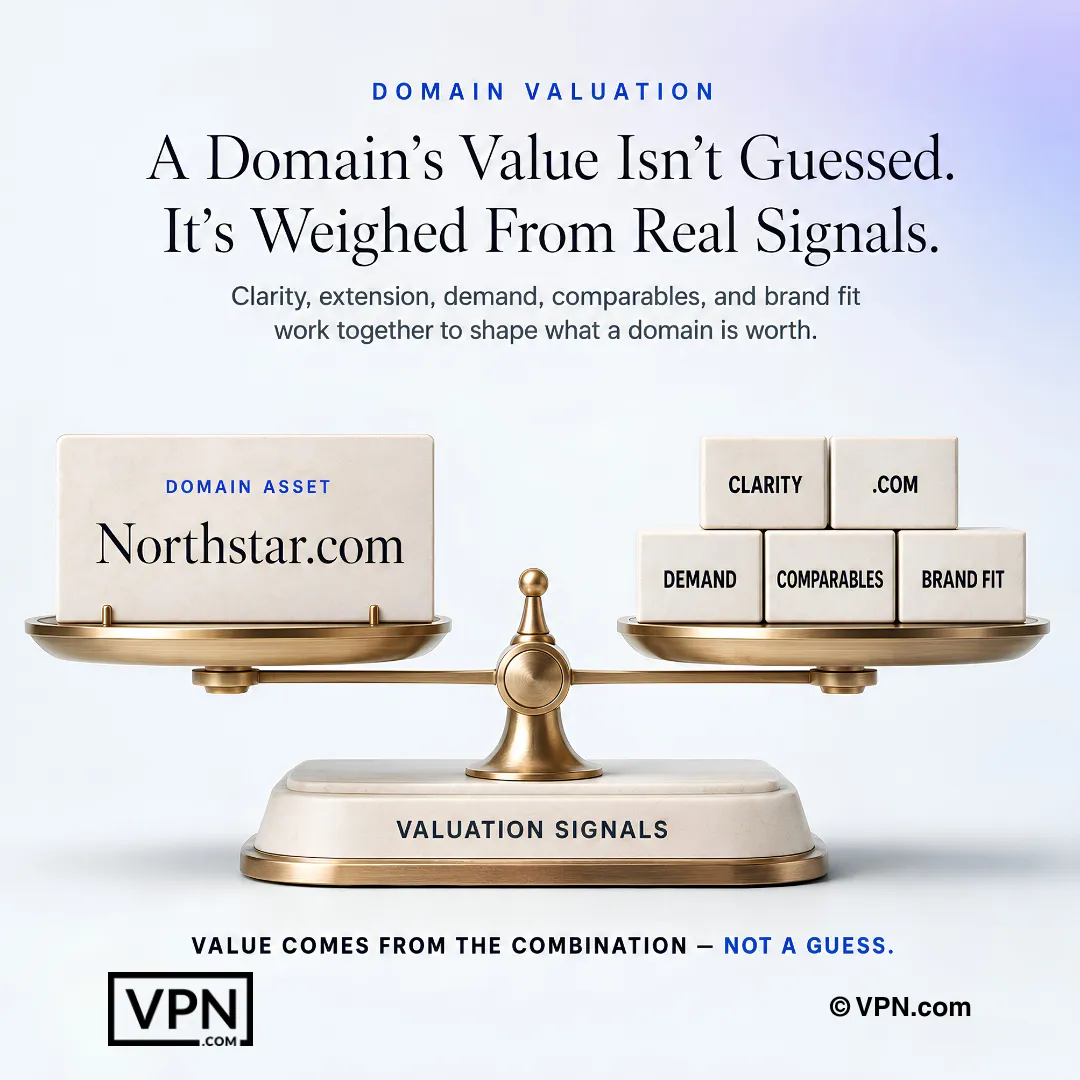
A credible domain valuation combines market evidence, extension quality, demand, clarity, and brand potential.
Explore domain brokerage
Buy Premium Domain: Expert Broker Service
Buy premium domain names through our broker service. We've advised on over $100M in portfolio and transactions with zero fees until closing. Start your confidential purchase today.
Confidential Domain Acquisition: Buy Domains Anonymously
Acquire premium domains without revealing your identity. VPN.com's confidential brokerage protects your leverage and keeps negotiations private.
Sell Premium Domain Names for Maximum Value
Sell your premium domain with expert broker representation. We've advised on over $100M in portfolio and transactions and negotiate top prices with zero upfront fees.
.com vs .xyz: The Real Differences Every Brand Should Know
Not sure whether to choose .com vs .xyz for your brand? We cover trust SEO email deliverability and cost to help you make a clear decision right now.
Domain Name and URL: What's the Difference?
Learn the key differences between domain name and URL. Understand how each works and why getting them right matters for your website's SEO and security.
Artificial Intelligence Domains: Buy AI Domains & Names
Explore artificial intelligence domains and AI-focused names. Learn pricing drivers, SEO and branding value, and how a broker helps you buy safely.
Frequently Asked Questions
What factors actually determine how much my domain is worth?
Six factors drive domain value: comparable sales, length and simplicity, extension strength, brand potential, organic traffic, and market timing. A 4-letter .com sold for $38,000 last quarter, setting a baseline for similar names. One-word .coms range from $500K to $15M, while every additional character cuts value by roughly 10-15%.
Why did an automated valuation tool give me a completely different number than a broker?
Automated tools miss 60-70% of a domain’s true market value because they can’t account for negotiation context, buyer motivation, or timing. In one VPN.com case, a tool valued a one-word .com at $1.2M, but our analysis of private comps and buyer competition produced a $600K-$900K range, and the deal closed at $715K.
How does VPN.com calculate a domain valuation?
Our process runs four steps: comparable sales analysis using both public and private transaction data from over $100M in portfolio and transactions, keyword and revenue modeling based on search volume and CPC rates, buyer universe mapping to gauge competitive demand, and negotiation intelligence on seller motivation or buyer urgency. Every valuation delivers a range, not one number.
Do I have to pay for a domain valuation?
No. VPN.com provides complimentary, broker-grade valuations with no obligation and no fee until a deal actually closes. This differs from paid appraisal services like Sedo or Afternic, which charge $50-$100 for human-reviewed estimates that still lack access to private sale data and buyer-side intelligence.
Why is a broker’s valuation more reliable than GoDaddy’s Appraisal tool or Estibot?
Because algorithms can’t process buyer intent. GoDaddy Appraisal skews toward retail pricing and lands within 50% of true value on commodity domains only, performing far worse on premium names. Estibot handles mid-range domains ($1K-$50K) reasonably well but fails on brandable, premium names where subjective value and private comps dominate.
How much does a domain’s length affect its price?
Significantly. One-word .coms routinely sell for $500K to $15M, while two-word .coms range from $5K to $2M depending on category. Every additional character reduces value by roughly 10-15%, and hyphens, numbers, or unusual spellings cut value dramatically, since “InsuranceQuotes.com” is worth exponentially more than “Insurance-Quotez.com.”
Does switching from .io or another extension to .com really change the price that much?
Yes, often by a wide margin. The .com extension commands a 3-10x premium over alternatives. A .io domain valued at $20K might fetch $150K as a .com. Country-code extensions like .co.uk or .de hold value in their local markets but trade at steep discounts globally, so extension strategy matters before you buy or sell.
Can existing traffic to my domain increase its valuation?
Yes. A domain receiving 5,000 monthly visitors carries a quantifiable revenue stream from type-in traffic, aged backlinks, and existing search rankings. Domains with 500+ referring domains and established authority can justify $50K-$500K premiums based on SEO value alone, since buyers calculate the cost of building that traffic from scratch.
How much does market timing affect what my domain is worth?
Market timing can shift domain value by 20-40%. Health-related domains spiked 35-50% during 2020, and AI domains jumped 200-400% between 2022 and 2024. Selling into a hot market or buying before a trend peaks changes the math significantly, which is why tracking industry cycles matters as much as the domain itself.
Will the buyer or seller know who I am during the valuation process?
No. VPN.com’s process is anonymous from the first call. Sellers never learn who is buying, and buyers never tip their hand. This confidentiality protects negotiation leverage on both sides, since revealing identity or intent early often shifts pricing power toward the other party before terms are set.
How long does it take to get a valuation and complete a sale?
A free valuation itself is quick, but full transactions typically close in 30–90 days. In one documented case, a SaaS company’s domain search took 37 days from first contact to transfer after public appraisals ranged $80K-$200K and VPN.com negotiated a $62K purchase by identifying the seller’s motivation to liquidate a portfolio.
Can a broker actually get a better price than the domain’s listed valuation?
Yes, in both directions. On a one-word .com, a $1.2M automated valuation was renegotiated down to $715K, saving roughly $485K against the seller’s opening ask. On the sell side, an investor holding a $150K offer saw VPN.com surface 4 additional qualified buyers, driving the final sale to $340K.
Why do asking prices for domains differ so much from what they actually sell for?
Because opening asks run 2-10x above closing prices in most private transactions. A listed price of $250,000 tells you nothing about whether $85,000 or $400,000 is the realistic outcome. This gap is exactly why VPN.com delivers a valuation range grounded in comps and buyer leverage rather than a single quoted figure.
What data does VPN.com use that free valuation tools don’t have access to?
Private transaction records. Public domain sales represent only 30-40% of total transaction volume, since the rest happens through brokers and corporate acquisitions that never hit a public database. VPN.com draws on private sale data from over $100M in portfolio and transactions, which can shift a valuation by 30-50% compared to public-data-only estimates.
Premium Domain Broker
Pay less. Earn more. Stay anonymous.
Looking to buy or sell a domain? We can help.
Get Started