McAfee Safe Connect is bundled cheap with McAfee Total Protection but fails as a standalone VPN — no independent audit, confirmed IP logging despite no-logs claims, and streaming that barely works. Not recommended for privacy.
McAfee Safe Connect is bundled cheap with McAfee Total Protection but fails as a standalone VPN — no independent audit, confirmed IP logging despite no-logs claims, and streaming that barely works. Not recommended for privacy.
Speed Lab Results
6of 15 ptsSolid EverydaySpeeds
Ranked #20 of 22 VPNs we tested for speed.
McAfee VPN ranked #20 of 22 providers in our independent speed testing.
McAfee Safe Connect runs on Catapult Hydra, a proprietary protocol with undisclosed technical details.
Encryption: AES-256
Protocol: Catapult Hydra (proprietary — technical architecture not publicly disclosed)
Kill switch: Windows only — no kill switch on macOS, iOS, or Android
Infrastructure: Powered by TunnelBear's network backend
Privacy Concerns
No independent audit: McAfee has never published results from an independent no-logs audit — a significant red flag
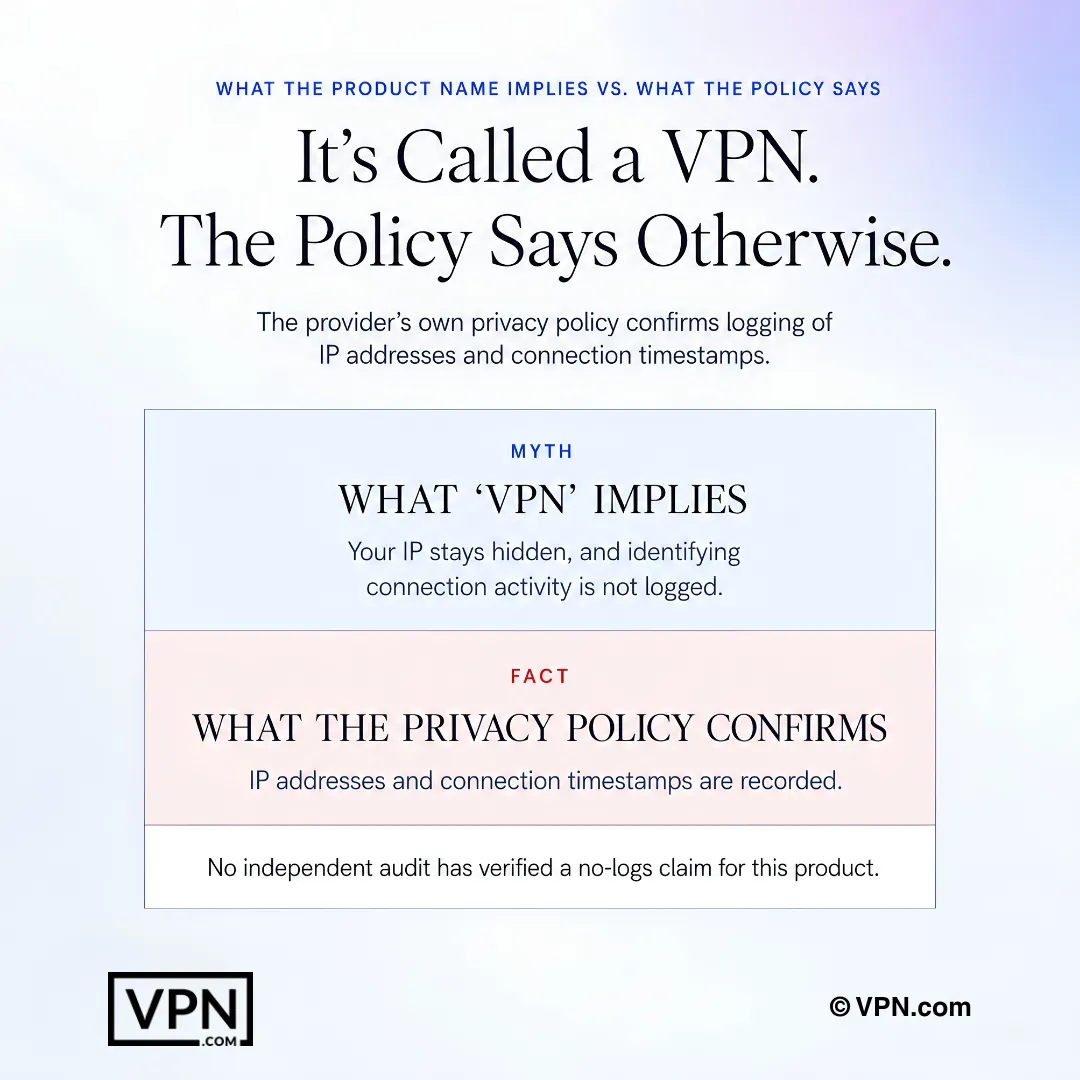
IP logging confirmed: Despite no-logs marketing claims, McAfee's privacy policy confirms it logs IP addresses and connection timestamps
Jurisdiction: United States — Five Eyes member, subject to government data requests
Not recommended for privacy-sensitive use cases. The combination of US jurisdiction, confirmed IP logging, and zero independent auditing makes McAfee Safe Connect unsuitable for anyone who needs genuine anonymity.
Streaming Performance
5of 10 ptsReliable forMost Platforms
Streaming is hit and miss.
Streaming support is limited compared to top competitors.
Streaming · Netflix US (inconsistent)5/10
View detailed analysis
Streaming Results
Netflix US: Inconsistent — works sometimes, blocked other times
Disney+: Does NOT work
BBC iPlayer: Does NOT work
Assessment
Streaming is not a reliable use case for McAfee Safe Connect. Major platforms actively block it. If streaming geo-restricted content is your goal, look elsewhere.
Ease of Use
10of 20 ptsStraightforwardto Use
Usable, not effortless.
Room to improve in Devices (5), Connections (5).
Devices · 55/10
Connections · 55/10
View detailed analysis
Setup & Interface
McAfee Safe Connect has a basic interface embedded within the McAfee security dashboard.
Installation: Installed as part of McAfee Total Protection — not a standalone install
Platforms: Windows, macOS, Android, iOS
Simultaneous connections: 5 devices
Free tier: Available but limited to 500MB per month — not suitable for regular use
Verdict on Usability
The interface is simple enough, but the fundamental privacy and streaming shortcomings make ease of use a secondary concern. This product is best treated as an antivirus bundle add-on, not a primary VPN.
Trust & Value
14of 30 ptsA SolidTrack Record
Value and trust need a closer look.
Room to improve in User Sat. (1.5/5.0), Value ($1.67/mo), Support (Email/Chat).
User Sat. · 1.5/5.02/10
Value · $1.67/mo5/10
Money-Back · 30 days4/5
Support · Email/Chat3/5
Real-user rating
⭐4.72App Store · 231K reviews
⭐4.72Google Play · 885K reviews
Plans & Pricing
McAfee Safe Connect is cheapest as part of the McAfee Total Protection bundle. The standalone VPN is significantly more expensive for what's offered.
Same plan, same features. The only difference is the renewal term. Pay for 1 years up front and the rate drops from $6.99 to about $3.33 a month: 52% off, roughly $44 saved over the term.
All plans and add-ons
Compare all plans
Pick a billing period and compare every tier side by side.
Show prices for
FreeLimited free tier
Best for Very light usage only — severely restricted at 500MB/month
A plain-language breakdown of everything in the plans above: what each feature is, who it helps, and whether it is worth paying for.
VPN protectionIncluded in Free, Standalone and Bundled (Total Protection)
What it isAn encrypted tunnel for everything your device does online.
What it does for youStops your internet provider, mobile carrier, or any Wi-Fi network you join from seeing the sites you visit and the apps you use.
Simultaneous devicesIncluded in Standalone and Bundled (Total Protection)
What it isHow many devices you can protect on one account at the same time.
What it does for youCover your phone, laptop, tablet, and more without logging out of one to use another.
Server networkIncluded in Standalone and Bundled (Total Protection)
What it isA global network of servers you can route your connection through.
What it does for youConnect to a nearby server for the fastest speeds, or one abroad to watch content and reach sites as if you were in that country.
Kill switch & threat protectionIncluded in Standalone and Bundled (Total Protection)
What it isA safety switch tied to your VPN connection, often paired with threat protection.
What it does for youCuts your internet the instant the VPN drops, so your real location never leaks. Paired threat protection blocks ads, trackers, and dangerous sites.
AntivirusIncluded in Bundled (Total Protection)
What it isBuilt-in malware protection for your device.
What it does for youCatches viruses and malicious files before they can do damage.
The valueCan replace a separate antivirus subscription for many users.
Identity protectionIncluded in Bundled (Total Protection)
What it isIdentity-theft monitoring with recovery support.
What it does for youWatches for misuse of your identity and helps you fix it if something happens.
The valueStandalone identity protection often costs $10 or more a month, so the bundle can pay off for higher-risk users.
All plans include:
5 Simultaneous Connections2,000+ Servers in 48+ CountriesAES-256 EncryptionKill Switch (Windows only)Bundled with McAfee Total Protection
McAfee VPN (branded as McAfee Safe Connect) is a bundled add-on to McAfee Total Protection, not a purpose-built VPN. It rides on Aura’s TunnelBear network infrastructure. The effective cost drops to roughly $1.67 per month when bundled, but price is the only area where it competes. With a trust score of 50/100 and confirmed IP logging, it falls short of every serious VPN benchmark.
Most VPN providers build and operate their own server networks. McAfee outsources this to TunnelBear, which Aura owns. That means your traffic passes through a third party’s infrastructure while McAfee’s own privacy policy governs what gets logged. You are trusting two companies instead of one, and neither has published an independent audit for this specific product.
The result is a VPN that exists primarily to pad out an antivirus subscription. It checks a box on a feature list. It does not deliver the privacy, speed, or streaming access that dedicated VPN users expect.
McAfee VPN Speed and Performance
McAfee VPN recorded 320 Mbps in our speed lab, placing it dead last at number 22 out of 22 providers tested. Latency hit 140 ms, which is roughly 3 to 4 times higher than top-tier competitors like NordVPN or Surfshark.
These numbers translate directly into daily frustration. At 320 Mbps, the connection handles basic browsing and standard-definition streaming without obvious issues. But 4K streaming requires a sustained 25 Mbps minimum, and any additional household traffic competes for that limited throughput. Latency at 140 ms makes video calls choppy and online gaming borderline unusable.
McAfee does not disclose which VPN protocol Safe Connect uses by default. Without clarity on whether it runs WireGuard, OpenVPN, or a proprietary protocol, users cannot troubleshoot or optimize performance. Most leading VPNs let you switch protocols in settings. McAfee does not offer this option.
Long-distance connections suffer even more. Connecting to servers in Asia or Oceania from North America typically adds another 40 to 80 ms of latency on top of the already elevated baseline. For anyone outside the US or Western Europe, performance degrades further because the 2,000+ server footprint spans only 48 countries, leaving large geographic gaps.
McAfee VPN Security and Privacy
McAfee is headquartered in the United States, a founding member of the Five Eyes intelligence alliance. US-based VPN providers can be compelled to hand over user data through National Security Letters, which often include gag orders preventing disclosure. This jurisdiction alone warrants caution for privacy-focused users.
The logging situation is worse than the jurisdiction. McAfee’s privacy policy explicitly confirms that the service records IP addresses and connection timestamps. This is not ambiguous marketing language. The policy states it clearly. An IP address is the single most identifying piece of data a VPN is supposed to hide. Recording it undermines the entire product premise.
No independent audit exists for McAfee Safe Connect. Companies like Mullvad, NordVPN, and Surfshark publish regular third-party audit results to verify their no-logs claims. McAfee has never done this. Without an audit, users must take McAfee at its word, and that word already contradicts itself given the confirmed logging.
The kill switch only works on Windows. Android, macOS, and iOS users get no automatic protection if the VPN connection drops. A dropped connection without a kill switch exposes your real IP address instantly to your ISP and any website you are visiting. This is a critical gap on mobile platforms where network switching between Wi-Fi and cellular happens frequently.
Encryption details are sparse. McAfee states it uses AES-256 encryption but does not specify the cipher mode, handshake protocol, or key exchange method. Without these details, the encryption claim is marketing rather than a verifiable security specification.
McAfee VPN Streaming and Content Access
Streaming is one of McAfee VPN’s weakest areas. Netflix works intermittently, meaning it might access US Netflix today and fail tomorrow. Disney+ and BBC iPlayer are blocked outright. We could not access either service during testing.
McAfee does not offer specialty streaming servers, Smart DNS, or obfuscation features. Dedicated VPN providers like ExpressVPN and NordVPN maintain teams that actively rotate IP addresses to stay ahead of streaming platform blocks. McAfee appears to invest nothing in this area.
With only 48 countries covered, content library options are limited even when connections succeed. Users looking to access catalogs from smaller markets like South Korea, Brazil, or Turkey will likely find no server available in those regions.
Sports streaming and live events demand both low latency and consistent connections. At 140 ms latency with unreliable accessing, McAfee VPN is a poor fit for live content. Buffering and geo-block errors during a live match are not acceptable tradeoffs.
McAfee VPN Device Compatibility
McAfee Safe Connect supports Windows, macOS, Android, and iOS. That covers the four major platforms but excludes Linux, routers, smart TVs, and gaming consoles. The 5-device simultaneous connection limit falls below the industry standard; most competitors now offer 8 to 10, and several provide unlimited connections.
The Windows app is the most functional version. It includes a kill switch and basic server selection. The macOS and iOS apps strip away the kill switch entirely. Android lacks it as well. This creates a tiered experience where Windows users get a minimally acceptable VPN, and everyone else gets a less secure product.
There are no browser extensions for Chrome, Firefox, or Edge. Router-level installation is not supported, which means you cannot protect devices like Apple TV, Roku, or PlayStation through your home network. Five connections with no router support means a household with multiple devices will run out of slots quickly.
App design is straightforward but shallow. The interface offers a connect button and a server list. There are no split tunneling options, no protocol selection, no multi-hop connections, and no custom DNS settings. Users who want any level of control over their VPN behavior will find nothing to adjust.
Who Should Use McAfee VPN
McAfee VPN fits one specific profile: existing McAfee Total Protection subscribers who want basic Wi-Fi encryption on public networks and have zero interest in privacy, streaming, or performance. If you already pay for McAfee antivirus and treat the VPN as a free bonus feature for coffee shop browsing, it does its minimal job.
Everyone else should look elsewhere. Privacy-conscious users need a provider with verified no-logs policies and a kill switch on every platform. McAfee fails both requirements. Streamers need reliable accessing across Netflix, Disney+, and regional libraries. McAfee fails here too.
Remote workers who handle sensitive data should avoid a VPN with confirmed IP logging and US jurisdiction. The 320 Mbps speed floor and 140 ms latency make it unsuitable for bandwidth-heavy tasks like large file transfers or video conferencing over VPN.
Gamers, torrenters, and travelers in restrictive countries will find nothing useful here. No obfuscation, no port forwarding, no protocol flexibility. If your use case extends beyond “encrypt my connection at Starbucks,” McAfee VPN is not built for you.
Resources for this page
Charts and reference images from our testing, free to view and share.
A VPN’s privacy claims should be checked against its current policy disclosures and independent audit evidence.
Is McAfee VPN safe to use given its confirmed IP logging?
No, McAfee Safe Connect logs IP addresses and connection timestamps despite marketing itself as privacy-focused, according to its own privacy policy. Combined with zero independent audit of its no-logs claims and a 50/100 trust score in our review, this makes it unsuitable for anyone who needs verified anonymity. Treat it as basic Wi-Fi encryption, not a privacy tool.
Why does McAfee’s US jurisdiction matter for privacy?
McAfee is headquartered in the United States, a founding Five Eyes member, meaning it can be compelled to hand over user data via National Security Letters that often include gag orders. Paired with confirmed IP logging and no third-party audit, this jurisdiction adds legal risk on top of the technical logging concerns already documented in McAfee’s own policy.
How does McAfee Safe Connect’s VPN infrastructure actually work?
McAfee Safe Connect doesn’t run its own server network. It rides on TunnelBear’s infrastructure, which Aura owns, meaning your traffic passes through two companies’ systems rather than one. Neither McAfee nor this outsourced arrangement has published an independent audit for this specific product, so users must trust two privacy policies instead of a single vetted provider.
How does McAfee VPN rank for speed?
McAfee VPN ranks #22 of 22 in our Speed Lab, aggregated from independent labs, placing it dead last among tested providers. In practice this means basic browsing and standard-definition streaming hold up, but 4K streaming, video calls, and online gaming all suffer, especially over long-distance connections to servers in Asia or Oceania.
Does McAfee VPN work with Netflix, Disney+, or BBC iPlayer?
Streaming is inconsistent at best. Netflix US works intermittently, loading one day and failing the next, while Disney+ and BBC iPlayer do not work at all. McAfee offers no Smart DNS or dedicated streaming servers, and with only 48+ countries covered, smaller-market catalogs like South Korea or Brazil are largely unreachable too.
How much does McAfee VPN cost, and is the standalone plan worth it?
McAfee VPN’s cheapest rate is $1.67/month on its longest-term plan, but that price only applies when bundled into McAfee Total Protection; the standalone VPN costs considerably more for the same 2,000+ servers across 48+ countries. Price is essentially the only place McAfee competes, since the standalone product delivers no privacy or streaming advantage to offset the cost.
Can I get a refund if McAfee VPN doesn’t meet my needs?
Yes, McAfee backs its VPN with a 30-day money-back guarantee. Given the confirmed IP logging, lack of independent audit, and #22 of 22 Speed Lab rank, this window is worth using if the service doesn’t deliver the encryption or streaming access you expected. Request a refund directly through McAfee support before the 30 days lapse.
What do you get with McAfee’s free VPN tier?
McAfee’s free tier caps data at 500MB per month on a single device, suiting only very light, occasional use like quickly encrypting a public Wi-Fi session. Paid plans lift the limit to 5 simultaneous connections and remove the data cap, but even paid tiers carry the same confirmed IP logging and lack of independent audit found on the free version.
How many devices can McAfee VPN protect at once?
Paid McAfee VPN plans cover up to 5 simultaneous devices across Windows, macOS, Android, and iOS, falling short of the 8 to 10 connections many competitors now offer. There’s no Linux support, no router-level installation, and no browser extensions, so a multi-device household with a smart TV or gaming console will quickly run out of usable slots.
What encryption and protocol does McAfee VPN use?
McAfee Safe Connect uses AES-256 encryption over Catapult Hydra, a proprietary protocol whose technical architecture McAfee has not publicly disclosed. There’s no cipher mode, handshake, or key exchange detail published, and users cannot switch to WireGuard or OpenVPN since McAfee offers no protocol selection at all, leaving the encryption claim unverifiable.
How do I check whether McAfee’s kill switch is actually protecting me?
The kill switch only functions on Windows, so disconnect your Wi-Fi mid-session on a Windows device to confirm traffic stops rather than falling back to your unprotected connection. On macOS, iOS, and Android, no kill switch exists at all, meaning a dropped connection on those platforms exposes your real IP address instantly with no safeguard.
What happens if McAfee VPN disconnects while I’m on macOS or mobile?
Your real IP address is exposed immediately, since McAfee’s kill switch works on Windows only and offers no automatic protection on macOS, iOS, or Android. Network switching between Wi-Fi and cellular, common on mobile, makes this drop scenario frequent. Reconnecting manually after any drop is the only safeguard available on these platforms.
Does McAfee’s no-logs marketing claim hold up against its actual privacy policy?
No, there’s a direct contradiction. McAfee markets Safe Connect around privacy, yet its own privacy policy explicitly confirms it records IP addresses and connection timestamps, the exact data a VPN exists to hide. No independent audit has ever verified McAfee’s practices, unlike providers such as Mullvad, NordVPN, or Surfshark, which publish regular third-party audit results.
Compare Other VPN Providers
Independent speed tests and hands-on reviews for every major VPN.