ProtonVPN delivers strong privacy from Swiss jurisdiction with solid performance for streaming and everyday use.Our #1 free pick: ProtonVPN offers a genuinely usable free plan with unlimited data, and holds a 88/100 trust score.ProtonVPN delivers strong privacy from Swiss jurisdiction with solid performance for streaming and everyday use.ProtonVPN delivers strong privacy from Swiss jurisdiction with solid performance for streaming and everyday use.ProtonVPN delivers strong privacy from Swiss jurisdiction with solid performance for streaming and everyday use.ProtonVPN delivers strong privacy from Swiss jurisdiction with solid performance for streaming and everyday use.ProtonVPN delivers strong privacy from Swiss jurisdiction with solid performance for streaming and everyday use.ProtonVPN delivers strong privacy from Swiss jurisdiction with solid performance for streaming and everyday use.
One of the largest VPN networks globally with 15,000+ servers in 120+ countries. ProtonVPN offers extensive coverage and specialty servers for P2P, streaming, and obfuscation.
ProtonVPN excels across the board here, scoring 5/5 for Security and 10/10 for Protocol.
Security · Audited5/5
Protocol · WireGuard10/10
View detailed analysis
Encryption & Protocols
ProtonVPN uses industry-standard security protocols to ensure everyday privacy and protect users' data online.
Encryption: AES-256 & ChaCha20
Protocols: WireGuard, OpenVPN, Stealth & IKEv2
Kill switch: Available on supported platforms; works effectively during forced-disconnect tests
DNS leak protection: Enabled by default, with no DNS leaks detected during testing
Privacy Credentials
Jurisdiction: Switzerland
Logging policy: No activity or browsing logs stored. ProtonVPN adheres to a strict zero-logs policy.
Connection data: Only minimal operational data is collected for service functionality; no personal data is stored
Audits: Independent security firms annually audit and verify the zero-logs policy, confirming that ProtonVPN does not log user activity. Latest done by Securitum.
Advanced Features
Secure Core: Available for extra protection, routing traffic through multiple servers in privacy-friendly countries
Stealth protocol: To avoid restrictive networks and VPN blocks
Port forwarding: Available on select servers for specific use cases like secure hosting
Ad-blocking: Built-in NetShield to block ads, trackers & malware
Tor over VPN: Optional integration to enhance anonymity against online threats
VPN Accelerator: for optimized performance
Premium Proton Pass
Premium Proton Mail
Streaming Performance
7of 10 ptsReliable forMost Platforms
Handles most streaming, not all.
ProtonVPN accesses 6+ Services, though performance varies by region.
Streaming · 6+ Services7/10
View detailed analysis
Platforms Supported
Netflix
Amazon Prime Video
Disney+
BBC iPlayer
ITVX/ITV Hub
Hulu & Max
ProtonVPN uses high-speed servers and optimized connections to help you reliably access geo-blocked content without extra settings.
Streaming Quality
4K/UHD: Zero buffering, instant start
HD: Flawless on all services tested
Fast connections: Auto-selects the best server for streaming
Ease of Use
#1of 22Among the Easiestto Use
Easy on every device you own.
ProtonVPN excels across the board here, scoring 10/10 for Devices and 10/10 for Connections.
Devices · 1010/10
Connections · 1010/10
View detailed analysis
Setup & Interface
ProtonVPN is built for simplicity and gets users protected quickly without requiring technical knowledge.
Installation: Quick and straightforward, typically completed in a few minutes
Connect flow: Simple one-click connect for use
Platforms: Windows, macOS, Linux, Android & iOS
Simultaneous connections: You can connect up to 10 devices simultaneously on a single ProtonVPN account
Key Features
Quick Connect: Automatically selects the best server for optimal performance.
Server list: Clean, country-based server selection for easy navigation.
Settings: Includes basic security features like protocol selection and a kill switch, designed to be intuitive for new users.
No technical expertise required. If you can install regular software, you can set up ProtonVPN. Advanced users have granular control when needed.
Trust & Value
#1of 22Among the MostTrusted We Rank
Trusted at scale, priced fairly.
Strong scores in User Sat. (4.4/5.0), Money-Back (30 days), Support (24/7 Email).
User Sat. · 4.4/5.09/10
Value · $4.49/mo8/10
Money-Back · 30 days5/5
Support · 24/7 Email5/5
Real-user rating
⭐4.61App Store · 67K reviews
⭐4.7Google Play · 1.1M reviews
Plans & Pricing
ProtonVPN offers a free tier and two paid tiers. Plus tier gets full speed and server access. Unlimited adds Proton's privacy suite. All paid plans backed by 30-day money-back guarantee.
Same plan, same features. The only difference is the renewal term. Pay for 2 years up front and the rate drops from $9.99 to about $3.49 a month: 65% off, roughly $156 saved over the term.
All plans and add-ons
Compare all plans
Pick a billing period and compare every tier side by side.
Show prices for
Proton FreeForever free
Best for Basic private browsing, testing the service, light use with no cost
Medium speed VPN
Servers in 10 countries (random selection)
1 device
No logs, no ads, secure protocols
Basic free Mail/Drive/Pass features - Up to 5 GB storage
ProtonVPN exists because CERN scientists watched the Snowden revelations unfold and decided to act. The same team behind Proton Mail built this VPN to give ordinary people tools that journalists and activists rely on in high-risk environments. That origin story shapes every design decision the company makes.
Proton AG operates from Geneva, Switzerland. The company is employee-owned with no venture capital backing. This removes the most common conflict in the VPN industry: pressure to monetize user data when growth targets tighten.
With 15,000+ servers across 120+ countries, ProtonVPN combines serious infrastructure with a privacy-first philosophy. It also offers something rare among premium providers: a genuinely usable free tier that costs nothing and carries no data caps.
ProtonVPN Speed and Performance
The SpeedLab result of 580 Mbps places ProtonVPN at #12 of 22 providers tested. That number tells part of the story. Real-world performance depends on protocol choice, server distance, and what you actually do with the connection.
WireGuard delivers the fastest results on ProtonVPN. The company implements it as the default protocol on most platforms. OpenVPN remains available for users who prefer maturity and broad compatibility, though expect 15-25% slower throughput on the same server.
Latency sits at 22 ms, which keeps browsing and video calls responsive. Gamers will notice that number stays stable on nearby servers but climbs on distant Secure Core routes. For everyday browsing, streaming at 4K, and large downloads, 580 Mbps provides substantial headroom.
The VPN Accelerator feature deserves attention. ProtonVPN developed this technology to reduce latency and improve speeds on long-distance connections. It works at the protocol level and activates automatically. Users connecting to servers across continents see measurable improvement compared to standard routing.
Secure Core routing adds a privacy layer but reduces speed. Traffic bounces through hardened servers in Switzerland, Iceland, or Sweden before reaching the exit server. Expect throughput to drop by 30-50% on these routes. That tradeoff makes sense for threat models that justify it, not for Netflix browsing.
ProtonVPN Security and Privacy
Switzerland sits outside the Five Eyes, Nine Eyes, and Fourteen Eyes intelligence-sharing alliances. Swiss law does not require telecommunications companies to store customer metadata for law enforcement. A foreign court order cannot compel Proton to hand over data. A Swiss court must independently authorize any disclosure, which creates a substantially higher bar.
No-logs policy verified by legal pressure
Many VPN providers claim zero-logs policies. ProtonVPN’s claim survived actual legal testing. In 2019, Swiss authorities compelled Proton to comply with a court order related to a criminal investigation. The result confirmed what Proton had always stated: the system stores no connection metadata, IP addresses, or session timestamps. There was nothing to hand over.
This is qualitatively different from a marketing claim or a voluntary audit. The architecture itself prevents compliance from conflicting with user privacy.
Open-source apps and third-party audits
All ProtonVPN client applications are fully open-source and published on GitHub. Windows, macOS, Linux, iOS, and Android apps can be inspected by any security researcher. Few competitors match this level of transparency. ProtonVPN commissions regular audits from firms including SEC Consult and Cure53, and publishes results publicly.
Secure Core multi-hop routing
Secure Core routes traffic through hardened servers in privacy-friendly jurisdictions before it reaches the exit node. Even if an attacker monitors the exit server, they cannot trace traffic back to the user. The Secure Core servers operate in physically secured data centers in Switzerland, Iceland, and Sweden.
Encryption and kill switch
ProtonVPN uses AES-256 encryption with 4096-bit RSA key exchange. The kill switch blocks all internet traffic if the VPN connection drops. NetShield, a built-in ad and malware blocker, filters DNS requests to block trackers, ads, and known malicious domains at the network level.
ProtonVPN Streaming and Content Access
ProtonVPN accesses Netflix, Disney+, Amazon Prime Video, BBC iPlayer, and HBO Max on its Plus plan servers. The company maintains dedicated streaming-optimized servers that rotate IPs to stay ahead of VPN detection.
Reliability varies by platform and region. Netflix US works consistently. BBC iPlayer access remains stable through UK servers. Some regional libraries require switching between servers to find one that bypasses detection on a given day.
The free tier does not support streaming. Content platforms block free-tier IP ranges aggressively. Users who want reliable streaming access need a paid plan.
ProtonVPN lacks a SmartDNS feature. This means devices that cannot run VPN apps natively, like older smart TVs and some gaming consoles, require router-level configuration for streaming. Competitors like NordVPN and ExpressVPN offer SmartDNS as a simpler alternative for those devices.
ProtonVPN Device Compatibility
ProtonVPN supports 10 simultaneous connections on paid plans. Native apps cover Windows, macOS, Linux, iOS, Android, Android TV, and Chromebook. The Linux app includes a full GUI, which remains uncommon in the VPN market.
The Windows and macOS apps share a clean, map-based interface. Server selection feels intuitive. Users can browse by country, feature (Secure Core, P2P, streaming), or search for specific locations. The mobile apps mirror this design with touch-friendly adjustments.
Browser extensions for Chrome and Firefox provide lightweight protection without the full client. These extensions encrypt browser traffic only, not system-wide connections. Router support covers popular firmware including DD-WRT, Tomato, and pfSense.
The free plan allows 1 device and limits server access to 5 countries. Paid plans access the full 15,000+ server network across 120+ countries with 10 device connections.
Who Should Use ProtonVPN
ProtonVPN fits privacy-focused users who want verified protection backed by Swiss law and open-source transparency. Journalists, researchers, activists, and anyone operating under surveillance risk will find Secure Core routing and the court-tested no-logs policy genuinely valuable.
Everyday users who want a trustworthy VPN for browsing, streaming, and public Wi-Fi protection will also find ProtonVPN reliable. The 10-device allowance covers most households comfortably.
Budget-conscious users should start with the free tier. It offers unlimited bandwidth with no ads or data selling. No other reputable VPN matches this.
Speed-focused users who prioritize raw throughput above all else should consider alternatives. ProtonVPN’s 580 Mbps ranks mid-pack among tested providers. Gamers or users with gigabit connections who need maximum speed may prefer faster options.
Users who rely heavily on smart TV streaming without router configuration should note the missing SmartDNS feature. If that workflow matters, look at providers that include it natively.
Resources for this page
Charts and reference images from our testing, free to view and share.
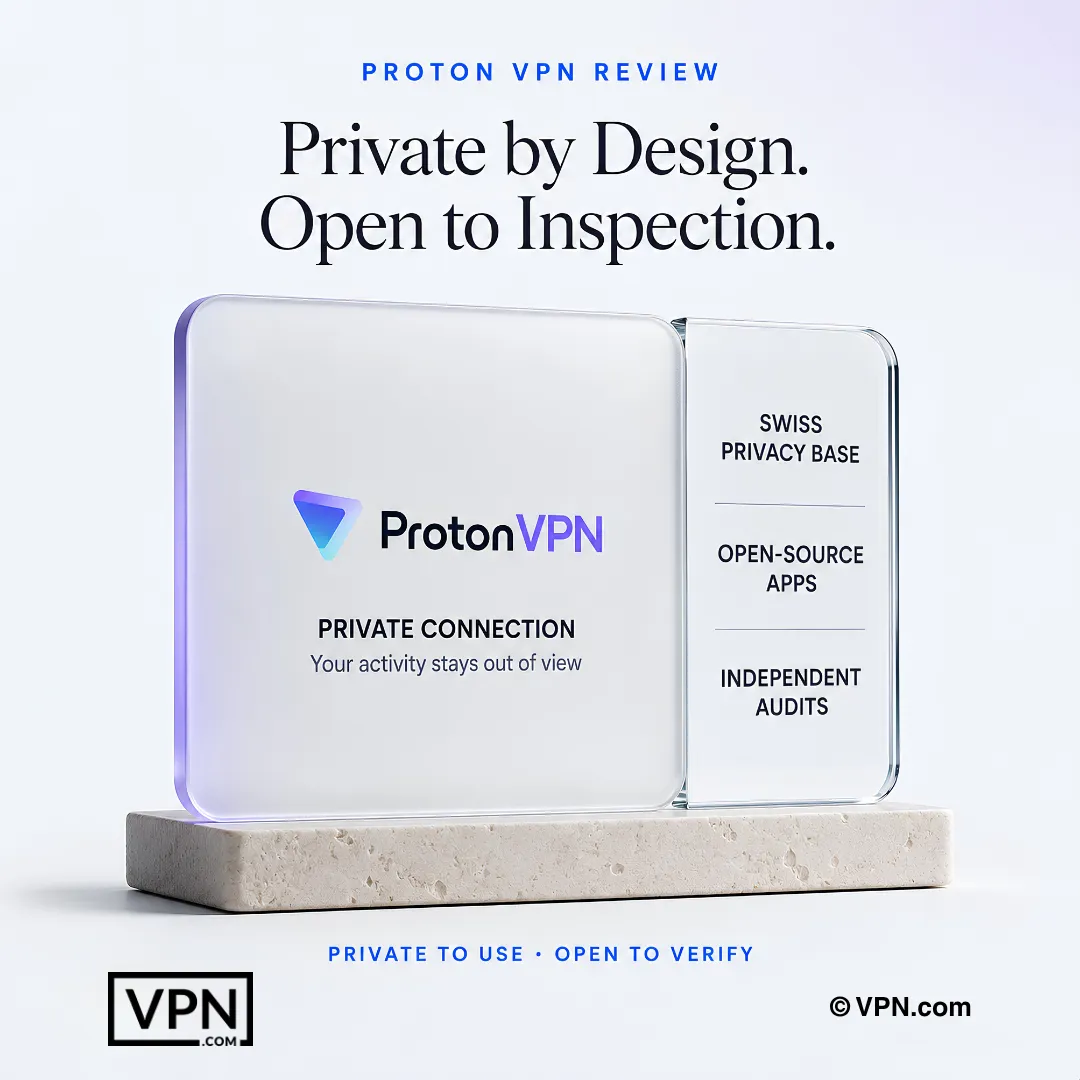
ProtonVPN combines Swiss privacy, open-source apps, and independent audits to make its protections easier to verify.
Who actually built ProtonVPN and why does that matter?
ProtonVPN comes from the same team behind Proton Mail, founded by CERN scientists after the Snowden revelations. Proton AG operates from Geneva, Switzerland, is employee-owned, and carries no venture capital backing. That structure removes the usual pressure VPN companies face to monetize user data when growth targets tighten.
Why does Swiss jurisdiction matter for ProtonVPN’s privacy claims?
Switzerland sits outside the Five Eyes, Nine Eyes, and Fourteen Eyes intelligence alliances, and Swiss law doesn’t require telecoms to store customer metadata for law enforcement. A foreign court order can’t compel Proton to hand over data directly. Any disclosure needs independent authorization from a Swiss court, which sets a notably higher legal bar than most jurisdictions.
Has ProtonVPN’s no-logs policy ever been tested by real legal pressure?
Yes, in 2019 Swiss authorities compelled Proton to comply with a court order tied to a criminal investigation. The result confirmed Proton’s claims: the system stored no connection metadata, IP addresses, or session timestamps, so there was nothing to hand over. That’s a court-tested outcome, not just a marketing promise or self-reported audit.
Are ProtonVPN’s apps and no-logs claims independently verified?
Yes. All ProtonVPN client apps for Windows, macOS, Linux, iOS, and Android are fully open-source and published on GitHub for public inspection. The company commissions regular third-party audits from firms including SEC Consult, Cure53, and Securitum, with results published publicly, covering both app security and the no-logs policy itself.
How does ProtonVPN’s speed compare against other VPNs we’ve tested?
ProtonVPN ranks #12 of 22 in our Speed Lab, aggregated from independent labs, putting it mid-pack. WireGuard runs as the default protocol and delivers the fastest results, while OpenVPN trails by roughly 15-25% on the same server. The VPN Accelerator feature further boosts throughput specifically on long-distance connections.
Which streaming platforms does ProtonVPN actually access, and does the free plan work?
ProtonVPN accesses Netflix, Disney+, Amazon Prime Video, BBC iPlayer, and HBO Max, but only on paid Plus plan servers. The free tier does not support streaming at all since content platforms aggressively block free-tier IP ranges. Reliability also varies by region, with some libraries requiring a server switch to find one that isn’t currently detected.
What do you actually get with ProtonVPN’s free tier?
ProtonVPN’s free tier includes unlimited bandwidth with no data cap, a rarity among free VPN plans, plus no ads and no data selling. It limits you to one device and randomly assigns a server from about 10 countries, with no streaming support. It’s a genuinely usable free option, not a stripped-down trial.
What’s the cheapest way to get ProtonVPN, and what do paid plans add?
ProtonVPN’s lowest price is from $2.49/month on its longest-term plan. Paid tiers access the full 15,000+ server network across 120+ countries, up to 10 simultaneous device connections, streaming access, NetShield ad and malware blocking, and Secure Core multi-hop routing, none of which the free tier includes.
What’s ProtonVPN’s refund policy if I decide it’s not for me?
ProtonVPN backs its paid plans with a 30-day money-back guarantee, giving you a full month to test speeds, streaming access, and Secure Core routing before committing long-term. Since the free tier costs nothing and has no data cap, you can also trial the core VPN experience indefinitely before ever paying.
How many devices can I actually run ProtonVPN on?
Device limits depend on your plan: free tier accounts are capped at 1 device, while paid plans support up to 10 simultaneous connections. Native apps cover Windows, macOS, Linux, iOS, Android, Android TV, and Chromebook, plus browser extensions for Chrome and Firefox that encrypt browser traffic only, not full system connections.
What is Secure Core and when should I actually use it?
Secure Core routes your traffic through hardened servers in Switzerland, Iceland, or Sweden before reaching the exit node, so even someone monitoring the exit server can’t trace traffic back to you. It reduces throughput by roughly 30-50%, so it makes sense for high-risk threat models like journalism or activism, not everyday Netflix streaming.
How do I use ProtonVPN on a smart TV or game console with no app?
ProtonVPN has no native smart TV or console app and, unlike NordVPN or ExpressVPN, lacks a SmartDNS feature, so you’ll need router-level configuration instead. ProtonVPN supports router firmware including DD-WRT, Tomato, and pfSense. Setting it up at the router protects every connected device without configuring each one individually.
What if ProtonVPN gets blocked on a restrictive or monitored network?
Switch to the Stealth protocol, which is designed specifically to get past restrictive networks and VPN detection where standard WireGuard or OpenVPN traffic gets flagged. If speed still suffers on a distant server, the VPN Accelerator feature can help, though Secure Core routes will run slower by design given their multi-hop architecture through hardened servers.
Compare Other VPN Providers
Independent speed tests and hands-on reviews for every major VPN.