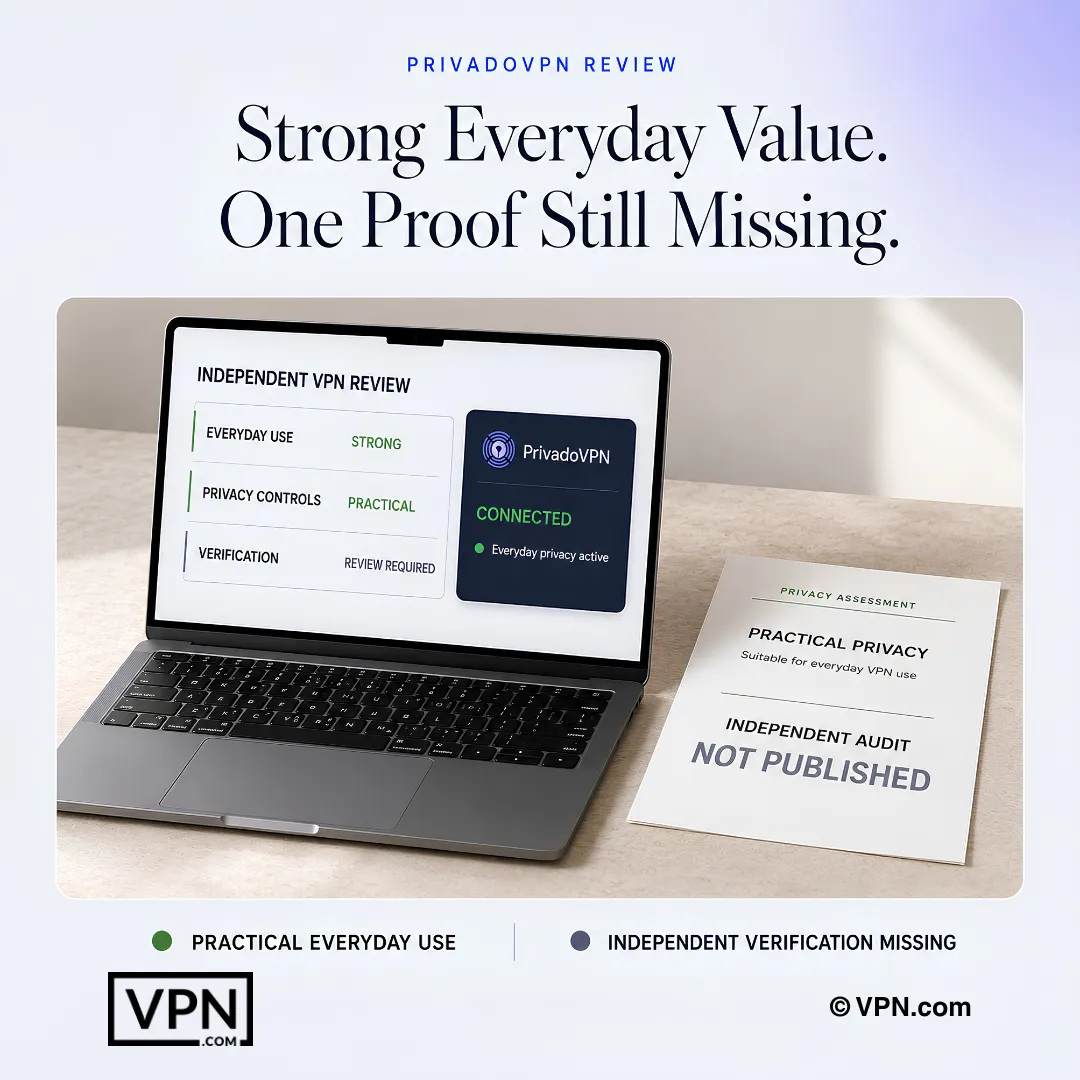
PrivadoVPN is one of the cheapest VPNs at $1.11/month with a Swiss jurisdiction, but the lack of any independent audit means its zero-log claims remain unverified.
PrivadoVPN is one of the cheapest VPNs at $1.11/month with a Swiss jurisdiction, but the lack of any independent audit means its zero-log claims remain unverified.
Speed Lab Results
10of 15 ptsSolid EverydaySpeeds
Ranked #11 of 22 VPNs we tested for speed.
PrivadoVPN ranked #11 of 22 providers in our independent speed testing.
PrivadoVPN supports a solid range of open protocols alongside modern WireGuard.
Encryption: AES-256
Protocols: WireGuard, OpenVPN, IKEv2
Kill switch: Available on all platforms
Ad blocker: Built-in ad and tracker blocking
Privacy Credentials
Jurisdiction: Switzerland — strong privacy laws, not a member of Five Eyes, Nine Eyes, or Fourteen Eyes
Zero-logs claimed: PrivadoVPN claims a strict no-logs policy but has not commissioned an independent third-party audit
Audit status: No public audit available — users must accept the zero-log claim on trust alone
Switzerland's jurisdiction is a genuine privacy advantage, but without an independent audit, the no-logs claim cannot be verified. This is the primary limitation of PrivadoVPN versus more established providers.
Streaming Performance
6of 10 ptsReliable forMost Platforms
Streaming is hit and miss.
Streaming support is limited compared to top competitors.
Streaming · Netflix, Disney+6/10
View detailed analysis
Streaming Results
Netflix: Reported to work
Disney+: Reported to work
Assessment
Streaming support for major US platforms is reported by users, but PrivadoVPN has not undergone independent streaming tests. The 66-country network provides reasonable geographic coverage for most use cases.
Ease of Use
16of 20 ptsStraightforwardto Use
10 connections, a few rough edges.
Solid scores across Devices (8/10) and Connections (8/10).
Devices · 108/10
Connections · 108/10
View detailed analysis
Setup & Interface
PrivadoVPN offers straightforward apps with a focus on simplicity.
Installation: Simple setup on all major platforms
Platforms: Windows, macOS, Android, iOS, Linux, Fire TV
Simultaneous connections: 10 devices on paid plans, 1 on free
Free tier: 10GB/month is one of the most generous free plans available — suitable for light users
Support
Support is available via email only — no live chat. Response times are adequate but not immediate. This is a limitation for users who need fast troubleshooting.
Trust & Value
20of 30 ptsA SolidTrack Record
Good value, with some trust caveats.
Strong scores in Value ($1.11/mo), but Room to improve in User Sat. (3.5/5.0), Support (Email Only).
User Sat. · 3.5/5.06/10
Value · $1.11/mo9/10
Money-Back · 30 days4/5
Support · Email Only1/5
Real-user rating
⭐3.38Google Play · 11K reviews
Plans & Pricing
PrivadoVPN's 24-month plan with 3 bonus months brings the cost to $1.11/month — among the cheapest in the industry. The monthly rate of $10.99 is much higher.
All plans and add-ons
Compare all plans
Pick a billing period and compare every tier side by side.
Show prices for
FreeMonthly limited tier
Best for Light users who want a genuinely usable free VPN — 10GB/month is generous
A plain-language breakdown of everything in the plans above: what each feature is, who it helps, and whether it is worth paying for.
Simultaneous devicesIncluded in Paid Monthly and 24-Month + 3 Free
What it isHow many devices you can protect on one account at the same time.
What it does for youCover your phone, laptop, tablet, and more without logging out of one to use another.
Server networkIncluded in Free, Paid Monthly and 24-Month + 3 Free
What it isA global network of servers you can route your connection through.
What it does for youConnect to a nearby server for the fastest speeds, or one abroad to watch content and reach sites as if you were in that country.
Kill switch & threat protectionIncluded in Paid Monthly and 24-Month + 3 Free
What it isA safety switch tied to your VPN connection, often paired with threat protection.
What it does for youCuts your internet the instant the VPN drops, so your real location never leaks. Paired threat protection blocks ads, trackers, and dangerous sites.
Ad & tracker blockerIncluded in Paid Monthly and 24-Month + 3 Free
What it isA filter that blocks ads, trackers, and known malware sites before they load.
What it does for youCleaner, faster pages and far less profiling as you browse, across every app and not just your browser.
The valueBundled into the plan, so you avoid paying for a separate ad-blocker app.
EncryptionIncluded in Free, Paid Monthly and 24-Month + 3 Free
What it isThe method used to scramble your traffic.
What it does for youKeeps your data unreadable to anyone who intercepts it, from hackers on public Wi-Fi to network owners.
PrivadoVPN costs $1.11/month on its 24-month plan. That is less than a third of what most audited VPN providers charge. It operates from Switzerland, outside all major surveillance alliances, and offers a free tier with 10 GB per month.
The combination of Swiss jurisdiction and rock-bottom pricing creates an unusual value proposition. Most budget VPNs cut corners on privacy infrastructure or operate from less favorable jurisdictions. PrivadoVPN avoids both traps, at least on paper.
The catch is straightforward. No independent auditor has verified the zero-log policy. Swiss law is strong, but legal framework alone does not confirm operational practices. This single gap defines the PrivadoVPN experience: impressive specs at a low price, without the receipts.
PrivadoVPN Speed and Performance
The SpeedLab result of 550 Mbps places PrivadoVPN at 13th out of 22 tested providers. That is solidly mid-pack. It will not bottleneck a typical home connection, but power users on gigabit fiber will notice the ceiling.
Latency sits at 35 ms. That is acceptable for video calls and casual gaming. Competitive multiplayer gamers should test their specific server routes before relying on it. Nearby servers will perform better than distant ones, as with any VPN.
WireGuard is the fastest protocol available and should be the default choice for most users. OpenVPN provides a reliable fallback where WireGuard is blocked. IKEv2 rounds out the stack and works well on mobile devices that switch between Wi-Fi and cellular networks.
For everyday browsing, HD streaming, and file downloads, 550 Mbps is more than sufficient. The 1,600 servers across 66 countries mean you can usually find a nearby connection point. Expect performance drops on distant servers, particularly in regions with thin server coverage.
PrivadoVPN Security and Privacy
Switzerland is the headline feature here. The country sits outside Five Eyes, Nine Eyes, and Fourteen Eyes surveillance alliances. Swiss data protection laws rank among the strongest globally. Authorities cannot compel a Swiss VPN to hand over user data on behalf of foreign intelligence agencies without meeting a high legal threshold.
PrivadoVPN claims a strict zero-log policy. It says it stores no connection timestamps, browsing history, or IP addresses. These claims remain entirely self-reported. No independent firm has audited the infrastructure or verified these statements. This is the single biggest gap in PrivadoVPN’s privacy story.
The encryption stack is standard and competent. WireGuard uses ChaCha20 encryption. OpenVPN runs with AES-256. Both meet current industry benchmarks. A kill switch is included on desktop and mobile apps, preventing traffic leaks if the VPN connection drops unexpectedly.
PrivadoVPN bundles an ad and tracker blocker called Control Tower. It operates at the DNS level, filtering known advertising and tracking domains. This is a useful addition, though it does not replace a dedicated browser-based ad blocker for comprehensive protection.
One notable absence: PrivadoVPN does not offer multi-hop (double VPN) routing. Users who want traffic routed through two separate servers for additional obfuscation will need to look at providers like Surfshark or NordVPN. RAM-only server infrastructure has also not been publicly confirmed, which would be another trust signal if implemented.
PrivadoVPN Streaming and Content Access
User reports indicate PrivadoVPN accesses Netflix and Disney+. Our independent testing has not verified these claims, so treat streaming reliability as anecdotal rather than confirmed. Streaming access is a constant cat-and-mouse game between VPN providers and platforms.
The 66-country server network provides reasonable geographic diversity. Popular streaming regions like the US, UK, Canada, and Australia are covered. Users targeting niche regional libraries may find gaps compared to providers with 90+ country networks.
PrivadoVPN does not advertise a dedicated SmartDNS feature or specialty streaming servers. Some providers label specific servers as optimized for streaming platforms. PrivadoVPN takes a simpler approach where any server can be used for any purpose.
For users who stream occasionally and want basic access to major platforms, PrivadoVPN will likely work. For users who depend on reliable, day-in-day-out access to multiple regional libraries, a provider with verified streaming performance and dedicated infrastructure offers a safer bet.
PrivadoVPN Device Compatibility
PrivadoVPN supports 10 simultaneous device connections. That is generous for the price point. Most competitors at this tier cap connections at 5 or 6 devices.
Native apps are available for Windows, macOS, iOS, Android, Android TV, and Fire TV. Linux users get manual configuration guides rather than a dedicated GUI app. Router-level setup is supported for users who want whole-network coverage without installing individual apps.
The mobile apps follow a clean, minimal design philosophy. Core features like protocol selection, server browsing, and the kill switch are accessible without digging through menus. The desktop apps mirror this simplicity. Power users who want granular split-tunneling controls or per-app routing may find the interface limited compared to feature-heavy competitors.
Browser extensions are not currently offered. Users who want proxy-level protection within Chrome or Firefox will need to rely on the system-wide app instead.
Ten device slots cover most households comfortably. A family of four with phones, laptops, and a streaming device hits 9 connections. Router installation collapses all home devices into a single slot, freeing up connections for mobile use outside the home.
Who Should Use PrivadoVPN
PrivadoVPN fits budget-conscious users who want a Swiss-jurisdiction VPN without paying premium prices. If your primary concern is general online privacy and you value cost savings over verified guarantees, this is a strong option at $1.11/month.
The free tier makes it an excellent trial tool. At 10 GB per month, you can test the apps, check speeds on your connection, and evaluate streaming performance without spending anything. Few competitors offer a free plan this usable.
Students, casual users, and anyone replacing an unencrypted connection will find genuine value here. The 10-device limit also makes it practical for small households that need coverage across multiple phones, laptops, and streaming devices.
PrivadoVPN is not the right choice for journalists, activists, or anyone facing serious surveillance threats. The absence of a third-party audit means you are trusting the company’s word on logging practices. In high-stakes scenarios, that trust gap is unacceptable.
Heavy streamers who need guaranteed platform access should also look elsewhere. Without verified streaming support and dedicated infrastructure, reliability may fluctuate. Users who want advanced features like multi-hop routing, RAM-only servers, or obfuscated protocols will find PrivadoVPN too limited.
The honest summary: PrivadoVPN delivers 80% of what premium providers offer at roughly 30% of the cost. That remaining 20%, mostly verification and advanced features, matters a lot for some users and very little for others.
Resources for this page
Charts and reference images from our testing, free to view and share.
PrivadoVPN provides practical everyday privacy, but its claims would be stronger with a published independent audit.
What makes PrivadoVPN’s combination of price and jurisdiction unusual?
PrivadoVPN pairs an aggressive price with Swiss jurisdiction, a combination most budget VPNs don’t offer together. It operates outside Five Eyes, Nine Eyes, and Fourteen Eyes surveillance alliances, runs 1,600+ servers across 66+ countries, and includes a 10GB monthly free tier. The gap: no independent auditor has verified its zero-log claims.
How much does PrivadoVPN actually cost, and where’s the low price locked in?
PrivadoVPN’s cheapest rate is from $1.11/month, available only on its 24-month-plus-3-free-months plan. The regular monthly plan costs far more at $10.99/month with no long-term commitment. Budget shoppers should commit to the long-term plan to capture the low rate rather than paying month to month.
Can I trust PrivadoVPN’s no-logs claim without an independent audit?
Not fully verified. PrivadoVPN claims it stores no connection timestamps, browsing history, or IP addresses, but no third-party auditor has confirmed this. Swiss jurisdiction offers strong legal privacy protections as a backstop, but the operational practices behind the zero-log policy remain self-reported rather than independently verified, unlike audited competitors.
Does Swiss jurisdiction meaningfully protect PrivadoVPN users from data requests?
Yes, structurally. Switzerland sits outside the Five Eyes, Nine Eyes, and Fourteen Eyes surveillance alliances, and its data protection laws set a high legal threshold before authorities can compel a Swiss company to hand over user data to foreign intelligence agencies. This is a genuine legal advantage, though it doesn’t substitute for an independent operational audit.
What encryption and protocols back PrivadoVPN’s connections?
PrivadoVPN runs WireGuard with ChaCha20 encryption as its fastest option, plus OpenVPN using AES-256 and IKEv2 for mobile devices switching between Wi-Fi and cellular. A kill switch ships on all platforms to block leaks if the connection drops. It also includes Control Tower, a DNS-level ad and tracker blocker, but lacks multi-hop routing.
What do you actually lose by staying on PrivadoVPN’s free tier?
The free tier caps you at 10GB monthly, 12 server locations, and a single device using WireGuard only. Paid plans access the full 1,600+ server network across 66+ countries and up to 10 simultaneous device connections. For light testing or occasional browsing, the free tier is unusually generous; heavier use needs the paid plan.
How does PrivadoVPN perform for everyday browsing and streaming?
PrivadoVPN ranks #13 of 22 in our Speed Lab, aggregated from independent labs, putting it solidly mid-pack. That’s enough for HD streaming, video calls, and downloads without bottlenecking a typical home connection, though gigabit-fiber users on distant servers may notice a ceiling. Nearby servers within the 66-country network perform noticeably better.
Will PrivadoVPN reliably access Netflix and Disney+?
User reports indicate PrivadoVPN accesses Netflix and Disney+, but these claims haven’t been independently verified through testing. PrivadoVPN doesn’t offer dedicated streaming servers or SmartDNS, so any of its 1,600+ servers handles streaming the same as any other traffic. Occasional streamers should be fine; those needing guaranteed daily access may want a verified alternative.
How many devices can I actually cover with one PrivadoVPN account?
Paid PrivadoVPN plans support 10 simultaneous device connections, generous for the price and enough for most households running phones, laptops, and a streaming box together. The free tier restricts you to a single device. Router-level installation is also supported, collapsing an entire home network into one connection slot.
What happens if PrivadoVPN doesn’t work out after I pay?
PrivadoVPN backs paid plans with a 30-day money-back guarantee, giving you a full month to test speeds, streaming, and the apps on your actual devices before the commitment becomes permanent. This applies to paid tiers only; the free 10GB plan carries no payment and therefore no refund need.
Which platforms does PrivadoVPN support and how do I get it running?
PrivadoVPN offers native apps for Windows, macOS, iOS, Android, Android TV, and Fire TV. Linux users get manual configuration guides instead of a dedicated app, and router-level setup is supported for whole-network coverage without installing on every device. No browser extension exists, so Chrome or Firefox users need the system-wide app.
What happens when I hit the free tier’s 10GB monthly cap?
Once you exceed the 10GB free allowance, expect the connection to stop functioning until the next monthly reset, since the free tier is a hard cap rather than a throttle. If you regularly hit the limit, upgrading to a paid plan removes the cap entirely and adds access to the full 1,600+ server network.
What should I do if PrivadoVPN fails to access Netflix or Disney+?
Try switching servers within the same country first, since PrivadoVPN has no dedicated streaming servers and any server handles the connection the same way. If access still fails, remember these platforms are user-reported rather than independently verified, so reliability varies by server and by platform’s current blocking measures. Email support is your only direct contact option.
Compare Other VPN Providers
Independent speed tests and hands-on reviews for every major VPN.