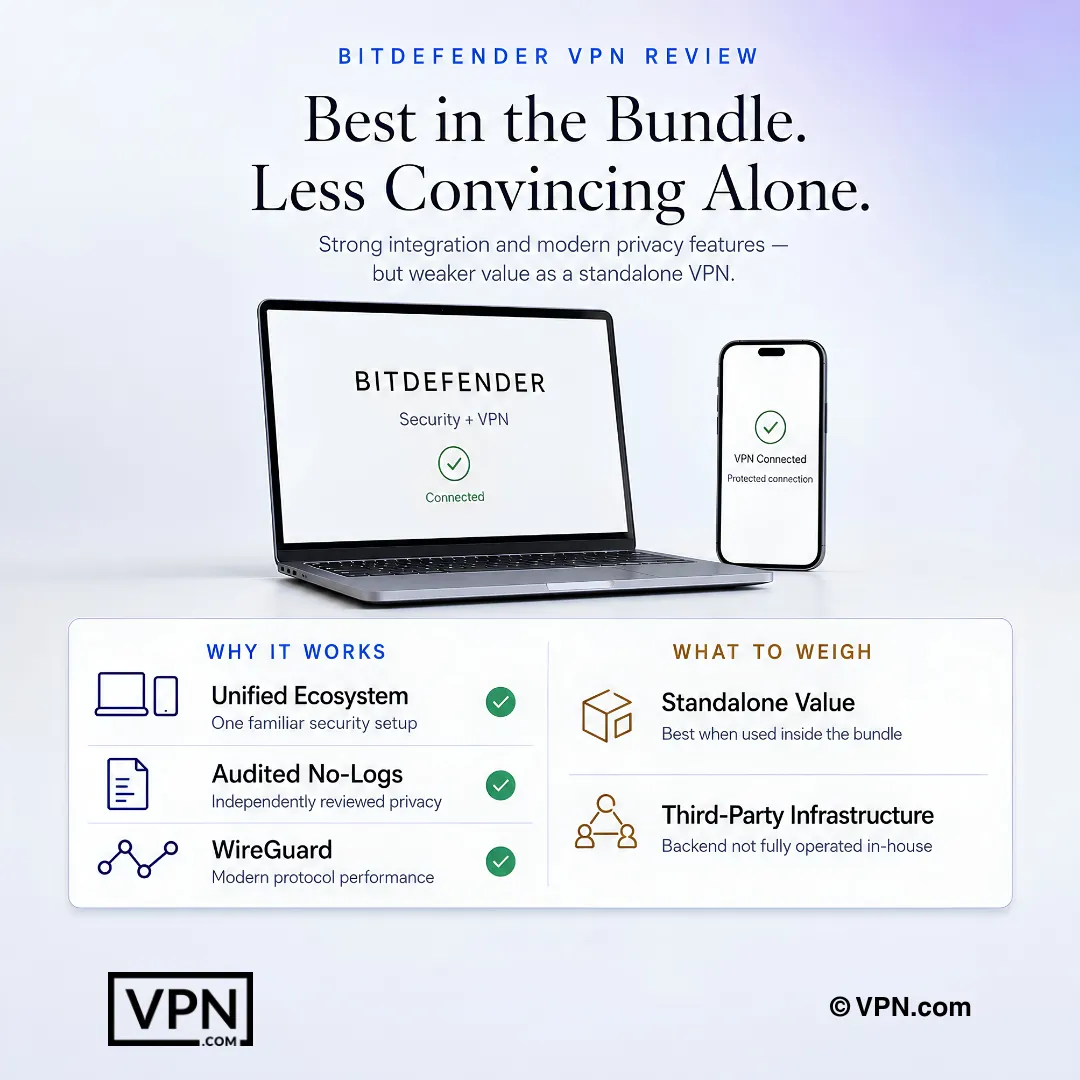
Bitdefender Premium VPN is best value when bundled with Bitdefender antivirus. A 2026 no-logs audit adds credibility, but the promotional pricing that triples on renewal and reliance on Hotspot Shield infrastructure are worth noting.
Bitdefender Premium VPN is best value when bundled with Bitdefender antivirus. A 2026 no-logs audit adds credibility, but the promotional pricing that triples on renewal and reliance on Hotspot Shield infrastructure are worth noting.
Speed Lab Results
10of 15 ptsSolid EverydaySpeeds
Ranked #11 of 22 VPNs we tested for speed.
Bitdefender VPN ranked #11 of 22 providers in our independent speed testing.
Protocol: WireGuard only — no OpenVPN or IKEv2 option
Kill switch: Available on all platforms
Double Hop: Routes traffic through two VPN servers for additional anonymity
Privacy Credentials
Jurisdiction: Romania — not a Five Eyes or Fourteen Eyes member
Audit: Independent no-logs audit completed in 2026, adding meaningful credibility
Infrastructure note: Powered by Hotspot Shield's Aura network — Bitdefender does not operate its own VPN backend
Streaming Performance
7of 10 ptsReliable forMost Platforms
Handles most streaming, not all.
Bitdefender VPN accesses Netflix, Disney+, Hulu, though performance varies by region.
Streaming · Netflix, Disney+, Hulu7/10
View detailed analysis
Platforms Supported
Netflix
Disney+
Hulu
Amazon Prime Video
Assessment
Streaming support is solid for US-based platforms. The 3,000+ server network across 50+ countries gives good geographic coverage. Speed lab testing has not been conducted, so raw performance remains unverified.
Ease of Use
16of 20 ptsStraightforwardto Use
10 connections, a few rough edges.
Solid scores across Devices (8/10) and Connections (8/10).
Devices · 108/10
Connections · 108/10
View detailed analysis
Setup & Interface
Bitdefender Premium VPN is designed to integrate cleanly with the Bitdefender security ecosystem.
Installation: Simple installer; can be added to an existing Bitdefender subscription
Platforms: Windows, macOS, Android, iOS
Simultaneous connections: 10 devices
Free tier: 200MB per day — useful only for brief testing
Pricing Transparency Warning
The first-year promotional price of $29.99 is attractive, but the renewal rate is approximately $69.99/year — more than double. Factor this into your long-term cost before subscribing.
Trust & Value
22of 30 ptsA SolidTrack Record
Good value, with some trust caveats.
Strong scores in Support (24/7 Chat), but Room to improve in Value ($2.50/mo).
User Sat. · 3.8/5.07/10
Value · $2.50/mo6/10
Money-Back · 30 days4/5
Support · 24/7 Chat5/5
Real-user rating
⭐4.81App Store · 13K reviews
⭐4.7Google Play · 55K reviews
Plans & Pricing
Bitdefender Premium VPN is heavily discounted in the first year ($29.99). Be aware the renewal price climbs to $69.99/year — nearly triple the introductory rate.
Same plan, same features. The only difference is the renewal term. Pay for 1 years up front and the rate drops from $6.99 to about $2.50 a month: 64% off, roughly $54 saved over the term.
All plans and add-ons
Compare all plans
Pick a billing period and compare every tier side by side.
Show prices for
FreeDaily limited tier
Best for Testing the service — 200MB per day is not enough for real use
A plain-language breakdown of everything in the plans above: what each feature is, who it helps, and whether it is worth paying for.
VPN protectionIncluded in Free and Premium VPN
What it isAn encrypted tunnel for everything your device does online.
What it does for youStops your internet provider, mobile carrier, or any Wi-Fi network you join from seeing the sites you visit and the apps you use.
Simultaneous devicesIncluded in Premium VPN
What it isHow many devices you can protect on one account at the same time.
What it does for youCover your phone, laptop, tablet, and more without logging out of one to use another.
Server networkIncluded in Free and Premium VPN
What it isA global network of servers you can route your connection through.
What it does for youConnect to a nearby server for the fastest speeds, or one abroad to watch content and reach sites as if you were in that country.
Kill switch & threat protectionIncluded in Premium VPN
What it isA safety switch tied to your VPN connection, often paired with threat protection.
What it does for youCuts your internet the instant the VPN drops, so your real location never leaks. Paired threat protection blocks ads, trackers, and dangerous sites.
Multi-hop (Double VPN)Included in Premium VPN
What it isRouting your connection through two VPN servers instead of one.
What it does for youAdds a second layer of anonymity for extra-sensitive browsing, at some cost to speed.
EncryptionIncluded in Premium VPN
What it isThe method used to scramble your traffic.
What it does for youKeeps your data unreadable to anyone who intercepts it, from hackers on public Wi-Fi to network owners.
No-logs policyIncluded in Premium VPN
What it isA policy, ideally independently audited, of not recording what you do online.
What it does for youMeans there is no browsing history on the VPN’s side to hand over, leak, or sell.
Bitdefender Premium VPN delivers genuine value for users already invested in the Bitdefender security ecosystem. Its 2026 no-logs audit, 10 simultaneous device connections, and introductory pricing of $29.99 per year make it a credible mid-tier option. The catch: renewal pricing nearly triples, and the underlying infrastructure belongs to Hotspot Shield.
Most antivirus companies slap a rebadged VPN onto their suite and call it a feature. Bitdefender took a different path. It commissioned an independent no-logs audit, implemented WireGuard across all platforms, and added Double Hop routing. These are features you normally find in dedicated VPN providers, not security suite add-ons.
The trust chain matters here. Bitdefender does not run its own server network. It resells infrastructure from Hotspot Shield’s parent company, Aura. The audit covers Bitdefender’s logging policy specifically, not the full infrastructure stack. That distinction separates Bitdefender from providers who own their hardware end to end.
Bitdefender VPN Speed and Performance
Our Speed Lab recorded 590 Mbps, placing Bitdefender 11th out of 22 tested providers. Latency measured 77 ms. Those numbers land squarely in the middle of the pack but tell only part of the story.
WireGuard does the heavy lifting here. The protocol is lightweight, establishes connections quickly, and handles server switching with minimal disruption. For everyday browsing, video calls, and standard-definition streaming, 590 Mbps is more than sufficient. Most home internet connections cap well below that figure.
The 77 ms latency deserves attention. Competitive online gaming typically demands latency under 50 ms. Casual gamers and general users will not notice the difference. Players in fast-paced shooters or fighting games should test local servers before committing.
With 3,000+ servers spread across 50+ countries, Bitdefender offers reasonable geographic coverage. Server density in popular regions like North America and Western Europe keeps speeds consistent during peak hours. Less popular locations may show more variability. Double Hop routing, which sends traffic through two servers, will reduce speeds further. Expect a noticeable throughput drop when using that feature. Reserve it for privacy-sensitive tasks rather than bandwidth-heavy activities.
Bitdefender VPN Security and Privacy
Bitdefender is headquartered in Romania. Romanian law does not mandate data retention for VPN providers, and the country sits outside the Five Eyes, Nine Eyes, and 14 Eyes intelligence-sharing alliances. This jurisdictional advantage aligns well with privacy-focused users.
The 2026 independent no-logs audit is the single biggest credibility boost for this service. Competitors like Avast SecureLine and McAfee VPN have never submitted to an equivalent review. The audit confirmed that Bitdefender does not store connection timestamps, browsing activity, or IP addresses. That verification puts real weight behind the privacy claims.
Encryption runs on AES-256, the same standard used by top-tier providers. The kill switch functions across all supported platforms, cutting internet access if the VPN connection drops unexpectedly. This prevents accidental data leaks during server switches or network interruptions.
Double Hop adds a second layer of routing. Your traffic passes through two separate VPN servers before reaching its destination. This makes traffic correlation attacks significantly harder. Few antivirus-bundled VPNs offer anything comparable.
The infrastructure caveat cannot be overlooked. Hotspot Shield’s Aura network handles the actual server operations. Bitdefender controls the client software, logging policy, and user-facing experience. Aura controls the metal. Users who demand full vertical integration should look at providers like Mullvad or IVPN that own and operate their own hardware. For everyone else, the audited logging policy provides a reasonable level of assurance.
Split tunneling is available on Android and Windows. It allows users to route specific apps through the VPN while others use the regular connection. This is useful for keeping local services like banking apps on a direct connection while protecting browser traffic.
Bitdefender VPN Streaming and Content Access
Bitdefender VPN accesses major streaming platforms with reasonable consistency. Netflix, Disney+, and Amazon Prime Video work on multiple server locations. BBC iPlayer access depends on the specific UK server selected.
There is no dedicated SmartDNS feature. Users who want VPN-free streaming on devices that do not support VPN apps (smart TVs, older gaming consoles) will need a router-level configuration. Dedicated streaming providers like ExpressVPN and NordVPN handle this more elegantly with built-in SmartDNS tools.
Bitdefender does not label servers by streaming platform. Users must test different locations manually to find one that works with their preferred service. This trial-and-error approach contrasts with providers that offer clearly marked streaming-optimized servers.
At 590 Mbps, the connection handles 4K streaming without buffering on most services. The 77 ms latency is invisible during video playback. Users streaming in regions far from available server locations may encounter occasional quality drops.
Bitdefender VPN Device Compatibility
Bitdefender VPN supports 10 simultaneous connections. That covers most households comfortably. A family of four with phones, laptops, and a tablet stays well within the limit.
Native apps are available for Windows, macOS, Android, and iOS. The Windows and Android apps offer the most complete feature sets, including split tunneling and Double Hop. The macOS and iOS apps are functional but lack split tunneling.
There is no native Linux client. Linux users must configure WireGuard manually, which requires intermediate technical knowledge. Browser extensions do not exist either. Router-level installation is possible but not officially supported with step-by-step guides from Bitdefender.
The app design follows Bitdefender’s broader interface language. It is clean and straightforward. Server selection uses a simple country list. There is no favorites system or latency-based auto-selection. The connect button does what it should without extra steps.
For users already running Bitdefender Total Security, the VPN integrates directly into the existing dashboard. This unified management is one of the strongest arguments for choosing this VPN over a standalone competitor. One interface controls antivirus, firewall, and VPN together.
Who Should Use Bitdefender VPN
Bitdefender VPN serves a specific audience well. Existing Bitdefender antivirus customers get the clearest benefit. Adding the VPN to a Total Security subscription keeps everything under one roof at a competitive introductory price of $29.99 per year.
Privacy-conscious users who want an audited VPN without switching their entire security setup will appreciate the 2026 no-logs verification. The Double Hop feature and Romanian jurisdiction add further appeal for this group.
Casual streamers and everyday internet users will find the 590 Mbps throughput and 10-device support more than adequate. The 3,000+ servers across 50+ countries cover most common use cases without complications.
This VPN is not ideal for power users who demand full infrastructure transparency. The Hotspot Shield dependency introduces a trust layer that purists will not accept. Gamers sensitive to latency should test thoroughly before committing, given the 77 ms average. Linux users face a subpar experience without a native client.
Budget-conscious buyers should plan for the $69.99 per year renewal price. The introductory rate does not last. At the renewal price, dedicated VPN providers with larger server networks and more features compete aggressively. Evaluate whether the Bitdefender ecosystem integration justifies the long-term cost.
Resources for this page
Charts and reference images from our testing, free to view and share.
Bitdefender VPN is most compelling for users already inside the broader Bitdefender security ecosystem.
What makes Bitdefender VPN different from typical antivirus-bundled VPNs?
Most antivirus suites bolt on a rebadged VPN with minimal features. Bitdefender commissioned an independent no-logs audit in 2026, runs WireGuard across all platforms, and added Double Hop routing that sends traffic through two servers. The catch is that Bitdefender doesn’t own its infrastructure. It resells capacity from Hotspot Shield’s parent company, Aura.
Is Bitdefender’s no-logs claim actually verified by an outside party?
Yes. An independent audit completed in 2026 confirmed Bitdefender does not store connection timestamps, browsing activity, or IP addresses. That puts it ahead of competitors like Avast SecureLine and McAfee VPN, which have never submitted to an equivalent review. Bitdefender is also headquartered in Romania, outside the Five Eyes, Nine Eyes, and 14 Eyes intelligence alliances.
Who actually runs the servers Bitdefender VPN traffic passes through?
Hotspot Shield’s Aura network operates the physical server infrastructure, not Bitdefender itself. Bitdefender controls the client software and logging policy, and its 2026 audit verified that policy specifically, not the full infrastructure stack. Users wanting a provider that owns its hardware end to end should look at Mullvad or IVPN instead.
How does Bitdefender VPN perform against other providers in speed testing?
Bitdefender ranks #11 of 22 in our Speed Lab, aggregated from independent labs, a mid-pack result. WireGuard, the only protocol Bitdefender offers, handles server switching quickly and keeps everyday browsing and standard-definition streaming smooth. Enabling Double Hop, which routes traffic through two servers for added privacy, will noticeably reduce throughput further.
Does Bitdefender VPN reliably access Netflix and other streaming services?
Bitdefender accesses Netflix, Disney+, Hulu, and Amazon Prime Video with reasonable consistency across its 3,000+ server network in 50+ countries. There’s no SmartDNS feature and no platform-labeled servers, so users must manually test locations to find one that works, unlike ExpressVPN or NordVPN, which mark streaming-optimized servers directly in their apps.
How much does Bitdefender VPN cost, and does the price jump later?
Bitdefender’s cheapest rate is from $2.50/month on its longest-term plan, a steep introductory discount off the $6.99/month regular rate. The first-year promotional price is heavily discounted, but the renewal rate roughly triples afterward. Budget for that jump before subscribing, since the value proposition changes significantly at renewal.
Is Bitdefender’s free VPN tier good enough for regular use?
No, it’s built for brief testing only. The free tier caps data at 200MB per day, offers no server selection, and provides only basic protection. The Premium plan removes those limits entirely, adding 10 device connections, a 3,000+ server network across 50+ countries, Double Hop, and a kill switch across all platforms.
What happens if I subscribe to Bitdefender VPN and want a refund?
Bitdefender backs Premium VPN with a 30-day money-back guarantee, giving you a full month to test the audited no-logs policy, WireGuard performance, and streaming access before committing long-term. Request the refund within that window if the service doesn’t fit, particularly useful given the steep price increase at renewal.
How many devices can I connect with one Bitdefender VPN subscription?
One subscription covers 10 simultaneous devices, comfortably fitting a household with phones, laptops, and a tablet. Native apps exist for Windows, macOS, Android, and iOS, but there’s no native Linux client and no browser extension. Split tunneling is only available on the Windows and Android apps, not on macOS or iOS.
What encryption and security features does Bitdefender VPN actually include?
Bitdefender uses WireGuard exclusively, with AES-256 and ChaCha20 encryption depending on the connection, and offers no OpenVPN or IKEv2 alternative. A kill switch runs across all supported platforms, cutting internet access if the VPN drops unexpectedly. Double Hop adds a second server layer, routing traffic twice to make correlation attacks harder.
Does Bitdefender’s Romanian jurisdiction create any privacy risk?
No, it’s actually favorable for privacy. Romania has no mandatory data retention law for VPN providers and sits outside the Five Eyes, Nine Eyes, and 14 Eyes intelligence-sharing alliances. Combined with the 2026 independent no-logs audit confirming no stored timestamps, browsing activity, or IP addresses, the jurisdiction supports rather than undermines Bitdefender’s privacy claims.
How do I turn on split tunneling in Bitdefender VPN?
Split tunneling is available in the Windows and Android apps only, letting you route specific apps through the VPN while others use your regular connection. It’s useful for keeping a local banking app or network printer outside the encrypted tunnel while your browser traffic stays protected. macOS and iOS users don’t have this option.
What if Bitdefender VPN doesn’t work on my smart TV or game console?
Bitdefender has no native app for smart TVs or older consoles and lacks a dedicated SmartDNS tool, unlike ExpressVPN or NordVPN. Router-level installation is technically possible but isn’t officially supported with step-by-step guidance from Bitdefender. Linux users face a similar gap, needing manual WireGuard configuration since no native Linux client exists.
Compare Other VPN Providers
Independent speed tests and hands-on reviews for every major VPN.