Our answer#1 of 5

ProtonVPN
Best Free VPNUnlimited free data · No-logs · Swiss-based.
Get ProtonVPN30-day money-back guarantee
Decision guide · Updated September 2026
Most free VPNs sell your data. These don't.
ProtonVPN
Best Free VPNUnlimited free data · No-logs · Swiss-based.
Get ProtonVPNThe ranking
Ordered by our overall score, aggregated from independent testing labs.



You want to secure your privacy online. But you are not ready to spend money on a VPN yet. That is completely reasonable. You searched for a free VPN, got overwhelmed with results, and now you have no idea which ones are trustworthy.
Here is what someone should have told you first: most free VPNs are terrible. Slow speeds, constant advertising, tiny data limits. Some secretly track and sell your browsing history to third parties. You went looking for privacy and found the opposite.
Remember Hola VPN? It turned its users’ devices into exit nodes, borrowing their bandwidth without permission. That is not protection. That is exploitation. Still, not all free VPNs are traps. Several are legitimate, usually stripped-down versions of established paid services that provide real privacy without monetizing your data.
That distinction matters. This guide identifies the free VPNs worth using, the ones that are tolerable with trade-offs, and the ones you should uninstall immediately.
Most VPN review sites rank options and move on. We think it is worth understanding what actually happens behind the scenes with free VPNs. Once you see the business model, everything else makes sense.
Running a VPN costs real money. Servers, bandwidth, maintenance, and staff require ongoing funding. When a VPN is completely free with no paid version, the obvious question is: how does the company generate revenue?
The most common methods include in-app advertising, selling anonymized browsing data to advertisers, using your bandwidth for other customers, or aggressively upselling a premium plan. None of these are automatic dealbreakers, but you should understand the model before you install anything.
This is the critical issue. A 2020 study found that many free VPN applications, especially on Android, had privacy policies that explicitly authorized selling user data to third parties. Others lacked a privacy policy entirely, which is arguably worse.
The irony is hard to ignore: you installed a VPN to stop tracking, and the VPN itself is tracking you.
Independent security researchers have found embedded ad trackers in free VPN apps on official app stores. In isolated cases, they discovered actual malware. App store review processes are imperfect, and bad actors know that “free VPN” is a search term millions of people use daily.
Always choose VPNs from known companies with verifiable track records and independent audits. If you have never heard of the developer and cannot find documentation about the company online, treat that as a warning.
Even the trustworthy free VPNs impose restrictions. Data caps between 500 MB and 10 GB per month are standard. Server options are minimal, meaning more users share fewer servers. That math translates directly to slower speeds. Most free plans cannot support HD streaming or torrenting.
Think of it as the express lane at a grocery store. Fewer registers are open, the line moves slower, and you can only bring a limited number of items.
The free VPNs we actually trust follow a consistent pattern: they are reduced versions of existing premium services. Companies like Proton, Windscribe, and hide.me offer free tiers so users can test their products. Because they generate revenue from paying subscribers, they have no need to sell your data.
That model genuinely works in your favor. Go in with realistic expectations. You get a taste, not the full meal. But at least it is honest.
Unlike most free VPNs, NordVPN has a verified no-logs policy independently audited by PwC and Deloitte, meaning your data is never collected, sold or shared with anyone. Try NordVPN today and get real privacy without the hidden cost.
We tested every free VPN on this list across multiple devices. We ran speed tests, read privacy policies, and used them in daily life. Here is what we found.
When someone asks us to name one free VPN to install, we recommend Proton VPN most often. It is the only reputable free VPN with unlimited data, no throttling, no ads, and no data selling. That combination is extremely rare.
Why It Stands Out
Most free VPNs use data caps to pressure you into upgrading. Proton does not need that tactic. Millions of paying subscribers fund the operation. The free tier represents genuine goodwill, and its construction reflects that. You get real privacy protection, not a degraded version designed to frustrate you into upgrading.
Key Strengths
Proton VPN is headquartered in Switzerland, outside the EU alliance and US surveillance networks, under some of the strongest privacy laws in the world. Its apps are fully open-source, meaning independent researchers can and do inspect the code for anything suspicious.
The no-logs policy has been independently audited. Proton uses WireGuard and OpenVPN protocols, includes a built-in kill switch, and provides DNS leak protection. This is not a toy. It is a serious privacy tool and one of the strongest free VPN options available.
Limitations
The free tier allows only one simultaneous connection. You cannot manually select a server; Proton auto-assigns the fastest one from the free pool. If you need a specific country for geo-accessing, results will vary. Speeds are solid for web browsing and video calls, but this tier is not designed for heavy streaming.
Key Features
Data Limits: Unlimited, no caps, no throttling
Server Locations: 8–10 countries including the US, Netherlands, Japan, Poland, Romania, Norway, Canada, Switzerland, Mexico and Singapore, auto-assigned
Supported Devices: Windows, macOS, iOS, Android, Linux, Android TV (1 simultaneous connection)
Windscribe is the strongest free VPN for users willing to prioritize privacy tools over unlimited data. Where Proton VPN covers the basics, Windscribe adds layers most premium VPNs skip.
Why It Stands Out
Windscribe’s built-in R.O.B.E.R.T. system blocks ads, malware, trackers, and even social media or gambling platforms at the DNS level. It protects every connection, not just traffic routed through a browser extension.
Windscribe also runs RAM-only servers. No data is ever physically stored on disk. If a server loses power, everything on it disappears permanently.
Key Strengths
Windscribe has undergone independent audits, publishes transparency reports, and offers a post-quantum encryption option, which protects today’s traffic against decryption by a future quantum computer. The free plan includes unlimited simultaneous connections, an exceptionally unusual feature that makes it viable for households with multiple devices.
Limitations
The 10 GB monthly cap is the main constraint. Casual browsing fits comfortably within that limit, but video streaming or other bandwidth-heavy activity will consume it quickly.
Key Features
Data Limits: 10GB per month (15GB if you tweet about them)
Server Locations: 10 countries across North America, Europe and Hong Kong
Supported Devices: Windows, macOS, iOS, Android, Linux, browser extensions (unlimited simultaneous connections)
TunnelBear[1] is the VPN you can hand to someone with zero technical knowledge and walk away. It is the most user-friendly VPN we have ever tested, and that matters more than most people realize.
Why It Stands Out
The interface is simple, lighthearted, and free of technical jargon. You pick a country, tap connect, and a cartoon bear tunnels across a map. No protocol dropdowns, no configuration menus, no decisions. For someone who just wants protection with no learning curve, TunnelBear delivers.
Key Strengths
TunnelBear publishes annual independent security audits, a practice most paid VPNs avoid. That transparency has earned the company genuine credibility in the industry.
It includes a GhostBear obfuscation option that disguises VPN traffic as standard HTTPS. This is useful in environments that actively block VPN connections. The no-logs policy has been audited, and the company has not experienced a major privacy scandal.
Limitations
The 2 GB monthly data cap is the real constraint. One hour of HD streaming burns roughly 3 GB on its own. TunnelBear’s free plan works best as a tool for occasional tasks, not as an everyday solution. Heavier use requires upgrading.
Key Features
Data Limits: 2GB per month
Server Locations: 48 countries, full network access on the free plan
Supported Devices: Windows, macOS, iOS, Android (unlimited simultaneous connections)
Hide.me does not receive the same attention as Proton or Windscribe, but mobile users should give it serious consideration.
Why It Stands Out
Hide.me provides unlimited data on the free plan, which alone places it in a small category. What makes it especially strong for mobile users is the app design. The iOS version supports Siri shortcuts, letting you set voice commands to connect or disconnect.
The Android version includes programmable auto-connect rules. It connects automatically when you join an unknown Wi-Fi network and disconnects on trusted networks. These are features you would expect from a premium app, not a free one.
Key Strengths
Hide.me gives free users manual server selection across 7 countries, offering more control than Proton’s auto-assignment. The kill switch is fully configurable rather than a simple on/off toggle. On certain platforms, no account is required to use the free version, eliminating signup friction that deters privacy-conscious users.
Limitations
Our tests showed noticeably slower speeds compared to PrivadoVPN and Proton, particularly on heavily loaded servers. Seven server countries may not be enough if you need a specific location outside the list. The free tier also limits you to one simultaneous connection.
Key Features
Data Limits: Unlimited
Server Locations: 7 countries, Finland, France, Germany, Netherlands, Switzerland, UK and US
Supported Devices: iOS, Android, Windows, macOS, Linux, browser extensions (1 simultaneous connection)
If raw speed is your priority, PrivadoVPN is the fastest free VPN we tested. The gap between PrivadoVPN and every other free option was not close.
Why It Stands Out
PrivadoVPN hit 900 Mbps in our performance tests on a high-speed connection using WireGuard. That is faster than most paid VPNs, let alone free ones. For reference, stable 4K streaming requires roughly 25 Mbps. PrivadoVPN’s free tier exceeds that threshold by a massive margin.
When you hit the 10 GB monthly cap, PrivadoVPN does not cut your connection. Instead, it throttles speeds to 2–4 Mbps. You can still browse and handle basic tasks, but premium speeds are gone. That gradual reduction is far more practical than a hard cutoff.
Key Strengths
Beyond speed, PrivadoVPN includes Smart Route split tunneling. You choose which apps route through the VPN (sensitive browsing) and which use a direct connection (gaming, office apps).
PrivadoVPN also performed well in our streaming tests, accessing content on several platforms where other free VPNs failed.
Limitations
The 10 GB monthly cap is the constraint you must plan around. At these speeds, half a day of HD streaming can consume the entire allowance. The free tier also restricts you to one device, which is inconvenient if you regularly switch between a laptop and phone.
Key Features
Data Limits: 10GB per month, then throttled to 2–4 Mbps (not cut off)
Server Locations: 10–12 countries and cities including the US, UK, Canada, Germany, Netherlands, India, Mexico, Brazil, Argentina and France
Supported Devices: Windows, macOS, iOS, Android, Linux (1 simultaneous connection)
We did not download a collection of apps and pick the prettiest interface. Here is what we actually examined before making any recommendation.
This was our first filter. We read through privacy policies, the dense legal documents, to verify what each VPN collects, stores, and potentially shares. A genuine no-logs policy means the provider does not record your browsing history, connection timestamps, or IP address.
If a privacy policy was vague, full of loopholes, or nonexistent, the VPN did not pass our screening.
We ran speed tests across multiple free VPN servers at different times of day on a consistent base connection.
Free VPNs are almost always slower than paid ones, so we did not expect miracles. We wanted to identify which ones were slow but usable and which were slow to the point of being unusable. Consistency mattered equally. A VPN that delivers 50 Mbps today and 2 Mbps tomorrow is not one we recommend.
Every free VPN we tested imposes some form of limitation. We documented the exact data allowance each one provides, how often it resets, and whether features like streaming or torrenting are available on the free plan. No details hidden in the fine print.
More server locations generally mean greater flexibility and better speeds. We verified how many countries each free tier serves and whether those servers are actually useful for common scenarios like accessing US or UK content, rather than token servers in obscure locations.
A VPN that is difficult to install defeats its own purpose. We evaluated app simplicity across Windows, Mac, Android, and iOS. Clean interface, straightforward connection process, no unnecessary hoops. If we needed a tutorial just to connect to a server, that signals a problem.
We examined the broader picture. Has the company undergone independent audits? Has it experienced a data breach? Does it explain how it funds the free tier? A VPN company’s history reveals far more than its marketing copy.
| Feature | Free VPN | Paid VPN |
|---|---|---|
| Data cap | 500 MB – 10 GB/month (Proton: unlimited) | Unlimited |
| Server locations | 5–10 countries | 60–100+ countries |
| Speed | Slower, shared servers | Faster, dedicated infrastructure |
| Simultaneous connections | 1 (most providers) | 5–10+ (some unlimited) |
| Kill switch | Sometimes | Always |
| Streaming | Rarely reliable | Reliable (varies by provider) |
| Privacy audits | Proton VPN, Windscribe | Standard across top providers |
| Price | Free | $2.49 – $6.67/mo |
This is the question we hear most often, and the honest answer is: the gap is substantial. Free VPNs have improved over time, but a meaningful difference remains between what you get for free and what you get when paying. Here is where that gap shows up.
Paid VPNs invest heavily in server infrastructure, delivering faster connections with less congestion. Free plans typically run on fewer servers shared by significantly more users. That ratio never works in your favor during peak traffic hours.
In our testing, paid VPNs were consistently faster, sometimes by a wide margin. Free VPNs handle light browsing adequately but slow down noticeably under bandwidth-intensive tasks.
A premium VPN like ExpressVPN or NordVPN provides access to thousands of servers across 90 to 150+ locations. Most free tiers? You get 5–10 locations, and sometimes the app selects the server automatically with no override.
That restriction matters when you need a specific country for geo-accessing or a geographically closer server for better speed.
This is probably the most frustrating practical difference. Paid VPNs offer unlimited data. Free VPNs cap you at as little as 500 MB/month, which disappears surprisingly fast. Even the more generous free options top out around 10 GB per month.
Casual browsing stretches that allowance reasonably far. Streaming, downloading, or working remotely will exhaust it quickly.
Netflix, BBC iPlayer, and Disney+ actively detect and block VPN traffic. Paid VPNs dedicate real resources to evading those blocks: rotating server IPs, obfuscation technology, and dedicated streaming servers.
Free VPNs generally lack the infrastructure for that ongoing cat-and-mouse game. In our streaming tests, free versions were unreliable more often than not.
Paid VPNs typically provide 24/7 live chat, detailed troubleshooting guides, and responsive support staff. Free VPN services may offer a help desk or slow email responses at best. When something breaks on a Sunday night, you are on your own.
Trustworthy free and paid VPNs often share the same fundamental encryption: AES-256, WireGuard, or OpenVPN protocols. But paid plans frequently include features that matter in practice: kill switches that cut your internet when the VPN drops, DNS leak protection, multi-hop connections, and obfuscated servers for restrictive networks. Free versions tend to strip these out or lock them behind a paywall.
Free VPNs serve a real purpose: privacy on coffee-shop Wi-Fi, light browsing, or testing VPN technology before committing financially. But they are not a complete substitute for a paid service.
We do not want this guide to read like a sales pitch for paid VPNs. The reality is that a free VPN can handle everything you need, depending on how you actually use the internet. Here are the scenarios where a free tier genuinely works.
This is the single best use case for a free VPN. Coffee shop networks, airport Wi-Fi, and hotel connections are genuinely dangerous. Anyone on the same network can potentially monitor your traffic. A free VPN encrypts that connection and makes you a significantly harder target.
You do not need unlimited data or 60 server locations for this. You just need encryption active, and every decent free VPN on this list handles that.
A free VPN is sufficient if your main concern is preventing your ISP from building a profile of your web activity or adding a basic layer of anonymity during normal browsing.
You are not streaming 4K video or downloading large files. You are reading, browsing, maybe checking email on a network you do not fully trust. For that level of usage, the data limits on a quality free plan are typically adequate.
Not everyone needs a VPN running 24/7. If you only activate it a few times per week for specific tasks, like accessing a blocked site, researching privately, or connecting through an unfamiliar network, a free VPN with a monthly data cap will last far longer than you might expect. Occasional use is where free VPN services make the most sense.
This gets overlooked. A free plan from a reputable provider is the most effective way to determine whether you actually benefit from using a VPN before spending money.
You can test the interface, measure the impact on your speeds, check compatibility with your devices, and decide whether VPN use fits your habits. Think of it as an extended free trial that does not require a credit card.
Free VPNs work for occasional use but if you find yourself hitting data caps or needing more servers, NordVPN starts at just a few dollars a month and removes every limitation a free plan comes with. Get NordVPN now and never worry about data caps or slow servers again.
Not all free VPNs are built the same, and not all users need the same features. Instead of handing you a ranked list and walking away, here is a practical framework for identifying which free VPN actually fits your needs.
Look for a VPN with a no-logs policy confirmed by a third-party audit. Jurisdiction matters. A VPN based in a privacy-friendly country like Switzerland or Iceland faces fewer government data requests than one headquartered in the US or UK.
Proton VPN remains the strongest choice in this category. It operates from Switzerland, has been independently audited, and its free tier does not compromise on privacy principles.
Focus on free VPNs that provide a reasonable number of servers and do not overcrowd free users. Both Windscribe and hide.me perform well relative to other free options.
Set realistic expectations. No free tier matches paid performance during peak hours. Connecting to a server geographically close to your actual location also helps more than most people realize.
Confirm that the VPN has a well-rated, actively maintained app on both Android and iOS. The free VPN experience on Android varies widely across providers. Some companies offer solid desktop apps but deliver buggy, slow, or outdated mobile versions that drain your battery or disconnect constantly.
Proton VPN and Windscribe both provide strong mobile experiences. Also verify whether the free plan supports more than one device simultaneously. Some providers restrict free plans to a single device.
Skip any free VPN that requires manual configuration or protocol selection before you can connect. Look for a clean, one-tap interface with sensible defaults. TunnelBear and hide.me both excel here. They are easy to set up, avoid overwhelming you with options, and do not bombard you with upsell prompts every time you open the app.
Data cap size matters less in this scenario than reliability and convenience. You want something that connects quickly, does not force you to log in every session, and simply works when you need it. Even a 500 MB monthly allowance stretches surprisingly far when used only a few times per month for specific tasks.
Any of the reputable free VPNs on this list will serve that purpose. Pick one from a known provider, install it, and keep it ready for when you need it.
After testing all of these options, here is the straightforward truth: no free VPN is perfect. Each one involves trade-offs. The right choice depends entirely on what you need.
If forced to recommend one option for most people, we would choose Proton VPN. Unlimited data, verified privacy credentials, and a company you can actually investigate. For most users, it delivers the strongest free VPN experience without any hidden compromises.
One final point: free VPNs are a starting point, not an endpoint. Until you are ready to upgrade, any of the five options above will serve you far better than the hundreds of questionable free VPN apps flooding the app stores. Stay safe out there.
Charts and reference images from our testing, free to view and share.
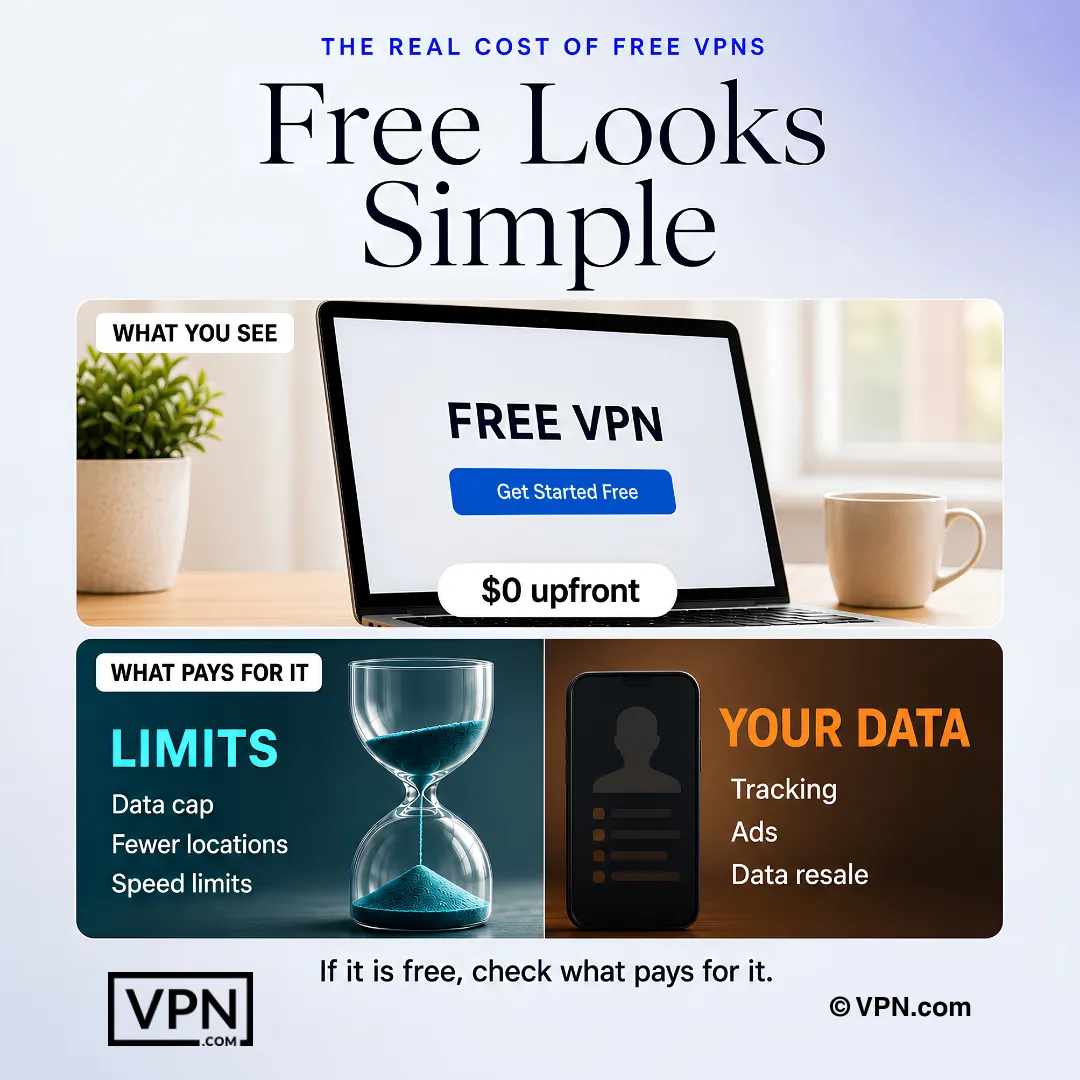
Most free VPNs cover costs through ads, upselling a premium plan, or selling browsing data, exactly what a VPN is supposed to prevent. A 2020 study found many free Android VPN apps had privacy policies explicitly authorizing data sales. Proton VPN, Windscribe, and hide.me avoid this because paying subscribers fund their free tiers, removing any incentive to sell your traffic.
Proton VPN, Windscribe, and hide.me are the safest since paying subscribers fund their free tiers rather than data sales. Proton is Swiss-based, independently audited, and fully open-source. Windscribe runs RAM-only servers and has had its apps audited by Cure53. TunnelBear has completed 8 annual Cure53 audits since 2017, though it’s owned by McAfee and based in Canada, a Five Eyes member.
Hola VPN turned users’ devices into exit nodes, borrowing their bandwidth for other customers’ traffic without meaningful consent, the opposite of the protection a VPN promises. It’s the exact risk pattern this guide screens against. That’s why only limited free tiers of established paid services, Proton VPN, Windscribe, hide.me, TunnelBear, and PrivadoVPN, made this list instead of unknown standalone free apps.
Free VPNs typically cap data between 500 MB and 10 GB monthly, cover 5 to 10 server countries versus far more on paid plans, and usually limit you to one simultaneous device. Kill switches exist on both, but features like multi-hop or obfuscated servers are common on paid tiers and often stripped from free ones. Paid plans among these providers start from $1.11/month (PrivadoVPN) up to $5.75/month (Windscribe) on their longest-term plans.
Proton VPN and hide.me both offer unlimited data on their free tiers, unusual in an industry where 500 MB to 10 GB caps are standard. Proton auto-assigns a server from its free pool and restricts free users to one device. Hide.me also limits free users to one device but lets you manually pick from several server countries instead. Every other option on this list caps data monthly.
Windscribe gives free users 10 GB monthly (15 GB if you tweet about the service) plus unlimited simultaneous device connections and its R.O.B.E.R.T. ad and tracker blocker. TunnelBear caps free users at just 2 GB monthly, roughly what one hour of HD streaming consumes, though it also allows unlimited devices and backs its security claims with 8 annual Cure53 audits since 2017.
hide.me ranks #6 of 22 in our Speed Lab, aggregated from independent labs, the strongest showing among the trustworthy free options covered here, though its free tier still limits you to one device and a handful of server countries. PrivadoVPN’s free tier also performs well and throttles rather than cuts you off once you exceed its 10 GB monthly cap, keeping basic browsing usable.
Sometimes, but reliability is inconsistent, since Netflix and Disney+ actively detect and block known VPN IP ranges, and free VPNs generally lack the dedicated streaming infrastructure paid plans invest in. PrivadoVPN’s free tier performed well accessing several platforms in testing, while TunnelBear’s free tier is unreliable, working on some servers and blocked on others. A paid plan with dedicated servers is the more dependable route.
It depends entirely on the provider. Windscribe and TunnelBear both allow unlimited simultaneous connections even on their free tiers, useful for multi-device households. Proton VPN, hide.me, and PrivadoVPN restrict free users to a single device at a time, though all three expand to up to 10 simultaneous connections once you upgrade to a paid plan.
Download only from the provider’s official app store listing or website, since independent researchers have found embedded ad trackers, and in isolated cases actual malware, in free VPN apps even on official stores. Search the provider’s name alongside “privacy policy” before installing; thin or missing results are a warning sign. Proton VPN, Windscribe, hide.me, TunnelBear, and PrivadoVPN all have verifiable histories worth checking.
It depends on the provider. PrivadoVPN throttles your speed rather than disconnecting you once you hit its 10 GB monthly cap, so basic browsing keeps working. Windscribe (10 GB) and TunnelBear (2 GB) simply stop connecting once you exceed their allowance. Proton VPN and hide.me never cap data on their free tiers, so this problem never applies to either one.
Yes, most of these providers back paid upgrades with a guarantee. Proton VPN, hide.me, and PrivadoVPN all offer a 30-day money-back guarantee on paid plans. Windscribe’s window is just 3 days, and TunnelBear handles refunds case-by-case with no fixed guarantee. Confirm the exact policy with support before committing to a longer paid term.
AES-256 encryption and a kill switch are standard across Proton VPN, Windscribe, hide.me, TunnelBear, and PrivadoVPN’s free plans. Proton and hide.me add WireGuard support with DNS leak protection. Windscribe layers in its R.O.B.E.R.T. ad and tracker blocker plus RAM-only servers, and TunnelBear adds GhostBear obfuscation with its VigilantBear kill switch. Paid tiers typically add extras like split tunneling that free plans strip out.