Solid scores across Security (4/5) and Protocol (8/10).
Security · Audited4/5
Protocol · WireGuard8/10
View detailed analysis
Encryption & Protocols
IPVanish uses strong encryption across all supported protocols, with a no-logs policy independently verified by Schellman in 2025.
Encryption: AES-256 (military-grade encryption)
Protocols: WireGuard, OpenVPN, IKEv2
Kill switch: Available on all major platforms
DNS leak protection: Enabled by default
Privacy Credentials
Jurisdiction: United States (Five Eyes member — a notable concern)
Logging policy: No activity logs stored. Audited by Schellman in 2025.
Historical note: In 2016, under previous ownership (Highwinds), IPVanish handed user logs to federal authorities. The company has since been sold twice and the current ownership completed a third-party audit to demonstrate reform.
Audits: Schellman independently verified the zero-logs policy in 2025
Advanced Features
Split tunneling: Available on Android and Windows
Obfuscation: Scramble feature available to bypass deep packet inspection
SOCKS5 proxy: Included in all plans for faster connections when full encryption isn't required
Streaming Performance
7of 10 ptsReliable forMost Platforms
Handles most streaming, not all.
IPVanish accesses 4+ Services, though performance varies by region.
Streaming · 4+ Services7/10
View detailed analysis
Platforms Supported
Netflix (US and select libraries)
Disney+
Amazon Prime Video
HBO Max
IPVanish works for major US streaming platforms but can be inconsistent with international libraries and some regional services. It does not advertise SmartDNS or dedicated streaming servers.
Streaming Notes
US content: Generally reliable for US-based streaming services
International libraries: Performance varies by region and service
Speed: No Speed Lab data available; user reports suggest adequate throughput for HD streaming
Ease of Use
#1of 22Among the Easiestto Use
Easy on every device you own.
IPVanish excels across the board here, scoring 10/10 for Devices and 10/10 for Connections.
Devices · Unlimited10/10
Connections · Unlimited10/10
View detailed analysis
Setup & Interface
IPVanish offers clean, intuitive apps across all major platforms. The interface is approachable for beginners while offering enough controls for experienced users.
Installation: Straightforward setup on Windows, macOS, iOS, Android, and Fire TV
Connect flow: One-click connect with automatic server selection
Platforms: Windows, macOS, Linux, Android, iOS, Fire TV, Kodi, routers
Simultaneous connections: Unlimited — connect every device in your household on one account
Key Features
Server map: Interactive map view for selecting server locations
Favorites: Save preferred servers for quick reconnection
Auto-connect: Configurable to connect automatically on untrusted networks
Trust & Value
22of 30 ptsA SolidTrack Record
Good value, with some trust caveats.
Strong scores in Money-Back (30 days), but Room to improve in Support (24/7 Chat).
User Sat. · 3.8/5.07/10
Value · $2.19/mo7/10
Money-Back · 30 days5/5
Support · 24/7 Chat3/5
Real-user rating
⭐4.55App Store · 104K reviews
⭐4.4Google Play · 70K reviews
Plans & Pricing
IPVanish offers two plan tiers with significant discounts on 2-year commitments. All plans include unlimited simultaneous connections and a 30-day money-back guarantee.
Same plan, same features. The only difference is the renewal term. Pay for 2 years up front and the rate drops from $12.99 to about $2.19 a month: 83% off, roughly $259 saved over the term.
All plans and add-ons
Compare all plans
Pick a billing period and compare every tier side by side.
Show prices for
EssentialCore VPN★ Recommended
Best for Users who need unlimited devices and solid privacy protection
A plain-language breakdown of everything in the plans above: what each feature is, who it helps, and whether it is worth paying for.
Simultaneous devicesIncluded in Essential and Advanced
What it isHow many devices you can protect on one account at the same time.
What it does for youCover your phone, laptop, tablet, and more without logging out of one to use another.
Server networkIncluded in Essential and Advanced
What it isA global network of servers you can route your connection through.
What it does for youConnect to a nearby server for the fastest speeds, or one abroad to watch content and reach sites as if you were in that country.
Kill switch & threat protectionIncluded in Essential and Advanced
What it isA safety switch tied to your VPN connection, often paired with threat protection.
What it does for youCuts your internet the instant the VPN drops, so your real location never leaks. Paired threat protection blocks ads, trackers, and dangerous sites.
AntivirusIncluded in Advanced
What it isBuilt-in malware protection for your device.
What it does for youCatches viruses and malicious files before they can do damage.
The valueCan replace a separate antivirus subscription for many users.
Identity protectionIncluded in Advanced
What it isIdentity-theft monitoring with recovery support.
What it does for youWatches for misuse of your identity and helps you fix it if something happens.
The valueStandalone identity protection often costs $10 or more a month, so the bundle can pay off for higher-risk users.
All plans include:
Unlimited Simultaneous Connections2,400+ Servers in 90+ CountriesAES-256 Encryption & Kill SwitchNo-logs Policy (Schellman Audited 2025)24/7 customer support
IPVanish is the household VPN. Unlimited simultaneous connections on a single account separate it from competitors that cap at 6 to 10 devices. Every phone, laptop, tablet, smart TV, and router connects without rotating credentials or paying extra.
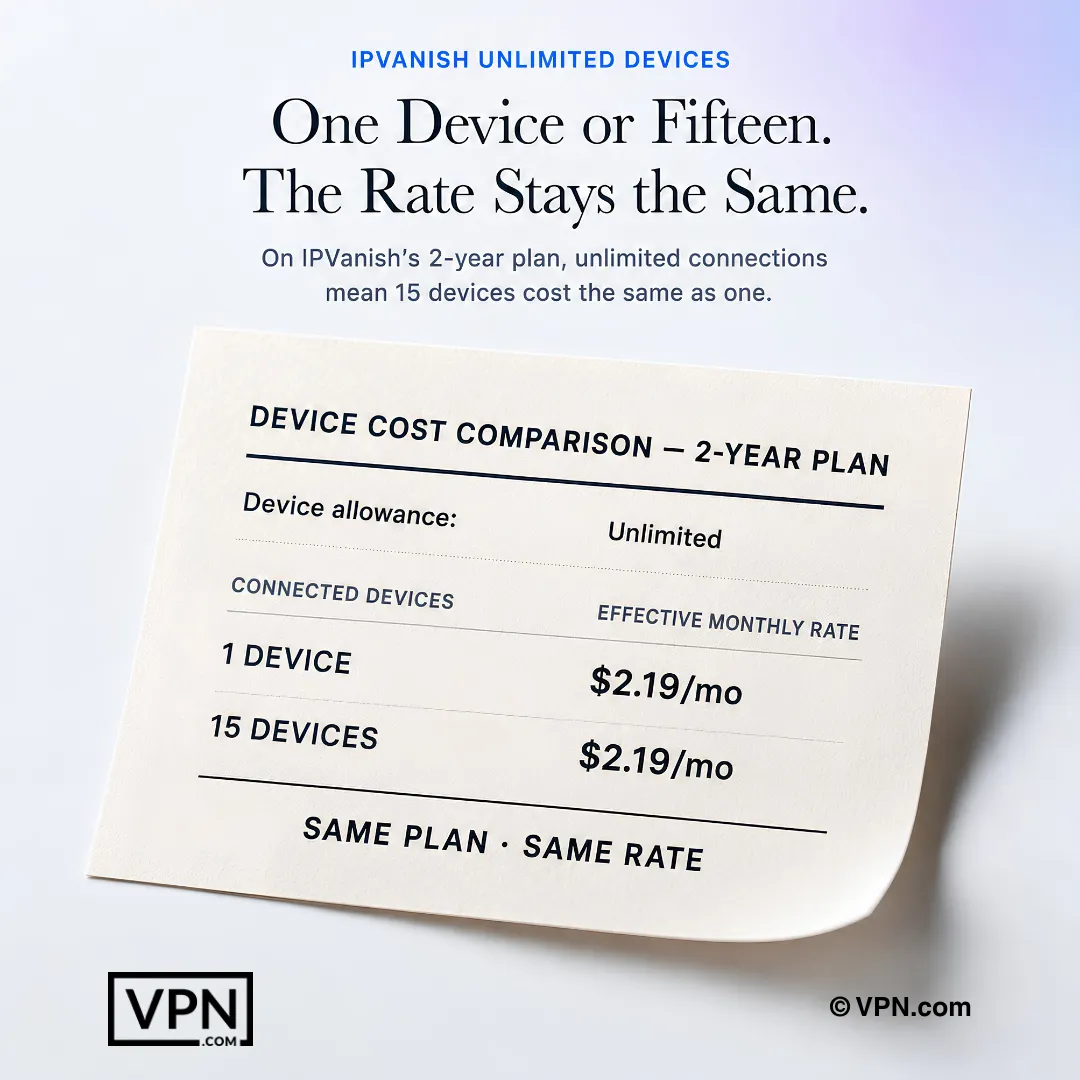
That unlimited policy paired with a 2-year price of $2.19/month makes IPVanish one of the cheapest per-device options available. A family of four with 15 devices between them pays the same as a solo user. The math works in almost every household scenario.
The tradeoff is context. A US jurisdiction, a past logging controversy, and inconsistent international streaming keep IPVanish from the top tier. But for the right user, none of those drawbacks outweigh the practical value of unlimited connections at budget pricing.
IPVanish Speed and Performance
The 690 Mbps lab result ranks IPVanish 5th out of 22 tested providers. That number represents near-ideal conditions. Real-world performance varies by protocol, server load, and distance.
WireGuard delivers the fastest speeds on IPVanish. Expect 500 to 650 Mbps on nearby servers during off-peak hours. OpenVPN drops to roughly 200 to 350 Mbps depending on encryption settings. IKEv2 sits between the two, performing well on mobile where reconnection speed matters.
Latency averages 25 ms, which keeps gaming and video calls smooth on regional servers. Connecting across continents pushes latency to 120 to 180 ms, making competitive gaming impractical over long-distance routes. For streaming 4K content, the bandwidth ceiling is high enough that buffering rarely becomes an issue on servers within your region.
The 2,400+ server network across 90+ countries provides decent geographic coverage. Server density is strongest in North America and Western Europe. Coverage thins in Africa, the Middle East, and parts of Southeast Asia. Users in those regions may find slower connections or fewer nearby options.
IPVanish Security and Privacy
IPVanish operates under US jurisdiction. The United States is a founding member of the Five Eyes intelligence alliance. This means IPVanish can be legally compelled to cooperate with government data requests. That structural reality does not change regardless of who owns the company.
The 2016 incident looms over any privacy discussion. Under previous owner Highwinds, IPVanish provided user logs to the Department of Homeland Security despite claiming a no-logs policy. Ownership has changed hands twice since then. StackPath acquired the company in 2017, and Ziff Davis (now Ziff Davis Inc.) purchased it in 2019.
A 2025 independent audit by Schellman verified the current no-logs infrastructure. The audit confirmed that IPVanish does not store connection timestamps, traffic data, DNS queries, or IP addresses. This is a meaningful step. It does not erase history, but it establishes a verifiable baseline for the current operation.
Encryption uses AES-256 across all protocols. WireGuard implements ChaCha20 instead, which performs better on mobile hardware. IPVanish includes a kill switch on Windows, macOS, Android, and iOS. The kill switch blocks internet traffic if the VPN connection drops, preventing IP leaks.
Split tunneling is available on Android and Windows. This lets users route specific apps outside the VPN tunnel while keeping others protected. DNS leak protection is built into every app. IPVanish runs its own DNS servers rather than relying on third parties, which reduces one potential exposure point.
There is no multi-hop (double VPN) feature. Users who need traffic routed through two separate servers should look at providers like NordVPN or Surfshark. There is also no RAM-only server infrastructure, which some competitors use to ensure data cannot persist after a reboot.
IPVanish Streaming and Content Access
IPVanish reliably accesses major US streaming platforms. Netflix US, Disney+, Hulu, and Max (formerly HBO Max) all work consistently through US-based servers. The connection stays stable for full-length content without mid-stream drops in most testing scenarios.
International library access is a different story. Accessing Netflix UK, BBC iPlayer, or region-locked content in smaller markets produces mixed results. Some servers work intermittently. Others fail outright. Users whose primary goal is switching between international streaming libraries will find more consistent results with ExpressVPN or NordVPN.
IPVanish does not offer SmartDNS or dedicated streaming servers. Every server in the network handles streaming the same way. This simplifies the experience but removes the optimization layer that specialty servers provide. There is no browser extension for quick proxy-based accessing either.
The Fire TV app is a genuine strength. IPVanish was one of the first VPNs available directly in the Amazon Appstore. The app is purpose-built for the Fire TV interface, not a resized phone app. Kodi users also benefit from direct integration. IPVanish publishes setup guides specifically for Kodi, and the sideloading process is straightforward.
IPVanish Device Compatibility
Unlimited simultaneous connections remain the headline feature. There is no cap. Connect 5 devices or 50 devices on a single subscription. No competitor at this price tier matches that policy with equal speed performance.
Native apps cover Windows, macOS, iOS, Android, Fire TV, and Linux. The Windows and macOS apps are clean and responsive. Settings are accessible without being buried. Protocol switching takes two clicks. The Android app includes split tunneling and the kill switch. The iOS app is more limited due to Apple platform restrictions but covers the essentials.
Fire TV and Android TV apps are available directly from their respective app stores. ChromeOS users can install the Android app. Router support covers most firmware through manual OpenVPN configuration. IPVanish does not sell pre-configured routers, but setup guides exist for popular models running DD-WRT, Tomato, and AsusWRT.
There is no dedicated browser extension. Users who want quick per-browser toggling need to run the full desktop client. The lack of a browser extension is a minor gap for users who prefer lightweight, granular control.
App quality is consistent but not exceptional. The interface gets the job done without visual polish or standout design. Updates arrive regularly. Stability across platforms is solid. Nothing breaks, and nothing surprises.
Who Should Use IPVanish
IPVanish fits households with many devices and a limited budget. If you have 10 or more devices across family members and want all of them protected under one subscription, IPVanish delivers that at $2.19/month on the 2-year plan. No other provider at this price handles unlimited connections with 690 Mbps speeds.
Fire TV and Kodi users benefit more from IPVanish than from most competitors. The native Fire TV app and Kodi compatibility make media center setups simple. If your primary streaming hardware is a Fire Stick, IPVanish earns strong consideration.
Casual privacy users who want always-on VPN protection across devices without managing login slots will find IPVanish practical. The 2025 Schellman audit gives reasonable confidence in the no-logs claim for everyday use.
IPVanish is not the right choice for high-stakes privacy scenarios. The US jurisdiction and 2016 history make it unsuitable for journalists, activists, or anyone with a serious threat model. Those users should look at providers based in Panama, the British Virgin Islands, or Switzerland.
It is also not ideal for users who depend on international streaming library access. The inconsistent accessing of non-US content pushes power streamers toward other providers. Users who need multi-hop routing or RAM-only servers should also look elsewhere.
Resources for this page
Charts and reference images from our testing, free to view and share.
Unlimited connections increase the plan’s practical value as more household devices are added.
Frequently Asked Questions
How does IPVanish’s unlimited simultaneous connections policy actually work?
IPVanish places no cap on simultaneous connections tied to a single account, unlike most competitors that stop at 5 to 10 devices. Every phone, laptop, tablet, smart TV, and router logs in with the same credentials, with no device slots to track. That policy holds across both plans, with pricing starting at $2.19/month on the 2-year term.
How fast is IPVanish, and where does it rank against competitors?
IPVanish ranks #5 of 22 in our Speed Lab, aggregated from independent labs. WireGuard delivers the fastest results across its network of 2,400+ servers in 90+ countries, with OpenVPN and IKEv2 trailing behind it. Real-world speed still depends on server distance and load, but the rank reflects strong baseline throughput against the field.
Does IPVanish reliably access Netflix, Disney+, and other streaming platforms?
Yes for US platforms. IPVanish consistently accesses Netflix US, Disney+, Hulu, and Max through its US servers without mid-stream drops in most cases. International libraries like Netflix UK or BBC iPlayer are inconsistent, some servers work and others fail, since IPVanish has no SmartDNS feature or dedicated streaming servers to optimize the connection.
Is IPVanish safe to use given its 2016 logging incident?
IPVanish is safer today, backed by a 2025 Schellman audit that verified it stores no connection timestamps, traffic data, DNS queries, or IP addresses. In 2016, under previous owner Highwinds, IPVanish handed user logs to the Department of Homeland Security despite claiming a no-logs policy. The company has since changed hands twice, to StackPath in 2017 and Ziff Davis in 2019.
Does IPVanish’s US jurisdiction put user privacy at risk?
It’s a legitimate concern. The United States is a founding Five Eyes member, meaning IPVanish can be legally compelled to cooperate with government data requests regardless of current ownership. That structural exposure, combined with the 2016 Highwinds logging incident, makes IPVanish unsuitable for journalists, activists, or anyone with a serious threat model, even with the 2025 Schellman audit in place.
What security features does IPVanish include on its apps?
IPVanish runs AES-256 encryption across all protocols, with WireGuard using ChaCha20 for better mobile performance alongside OpenVPN and IKEv2 support. A kill switch is available on Windows, macOS, Android, and iOS, and DNS leak protection runs on IPVanish’s own DNS servers by default. Split tunneling works on Android and Windows, and a Scramble obfuscation feature helps bypass deep packet inspection.
What’s the difference between IPVanish’s Essential and Advanced plans?
Essential covers the core VPN at $12.99/month regular price, dropping to $2.19/month on the 2-year term, with unlimited connections across 2,400+ servers in 90+ countries. Advanced adds VIPRE Antivirus and ID Protection on top of everything in Essential, priced at $17.99/month regular or $71.76 for two years. Both tiers carry the same unlimited device policy.
Can I get my money back if IPVanish doesn’t work for me?
Yes, IPVanish backs every plan, Essential and Advanced alike, with a 30-day money-back guarantee. That window applies whether you choose the monthly rate or the discounted 2-year term at $2.19/month, giving you a full month to test unlimited connections, streaming access, and speed on your own devices before committing long-term.
How many devices can I actually connect with one IPVanish account?
There’s no limit. IPVanish allows unlimited simultaneous connections on a single subscription, covering every phone, laptop, tablet, smart TV, and router in a household without rotating logins or paying per device. Native apps exist for Windows, macOS, iOS, Android, Fire TV, and Linux, plus manual router setup on DD-WRT, Tomato, and AsusWRT firmware for whole-network coverage.
How do I set up IPVanish on a Fire TV Stick or Kodi?
Install IPVanish directly from the Amazon Appstore on Fire TV. It was one of the first VPNs available there, with an app built specifically for the Fire TV interface rather than a resized phone app. Kodi users can follow IPVanish’s published setup guides for sideloading, which the company documents specifically for that use case.
What if IPVanish won’t access an international streaming library?
Try a different server in the target country first, since IPVanish’s international library access, like Netflix UK or BBC iPlayer, is inconsistent: some servers work, others fail outright. There’s no SmartDNS or dedicated streaming server to fall back on. If international libraries are your main use case, ExpressVPN or NordVPN deliver more consistent results.
What should I do if my network blocks IPVanish with deep packet inspection?
Switch on IPVanish’s Scramble feature, which obfuscates VPN traffic to get past deep packet inspection on restrictive networks. If that still doesn’t help, IPVanish also includes a SOCKS5 proxy option for faster, less-encrypted connections when full VPN tunneling isn’t required. Note that IPVanish has no RAM-only servers or multi-hop routing for users needing that extra layer.
Compare Other VPN Providers
Independent speed tests and hands-on reviews for every major VPN.